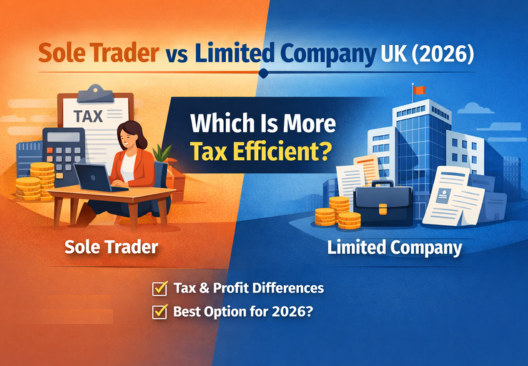
Sole Trader vs Limited Company UK (2026)
One of the most common questions we hear from business owners is simple:
“Should I stay a sole trader or switch to a limited company?”
And the honest answer is—it depends.
Not on trends, not on what others are doing, but on your numbers, your growth, and how you plan to run your business in 2026 and beyond.
Why This Decision Matters More Than You Think
Your business structure doesn’t just affect paperwork. It directly impacts:
- How much tax you pay
- How you take money out of your business
- Your legal liability
- How your business is perceived
Yet many business owners choose a structure at the start and never revisit it—even when their income grows significantly.
That’s where costly mistakes begin.
The Reality of Being a Sole Trader
Starting as a sole trader is straightforward. It’s quick to set up, easier to manage, and works well when you’re testing an idea or running a smaller operation.
But as profits increase, the downside becomes more visible. You’re taxed through Income Tax, and once your earnings cross certain thresholds, the tax burden rises quickly.
There’s also no separation between you and the business. From a legal standpoint, you are the business.
For some, that simplicity works. For others, it becomes limiting.
What Changes with a Limited Company
A limited company introduces more structure—but also more opportunity.
Instead of being taxed as personal income, profits are subject to Corporation Tax. You also gain flexibility in how you pay yourself, typically through a mix of salary and dividends.
This is where tax efficiency starts to improve, especially as profits grow.
There’s also the added benefit of limited liability, which means your personal assets are generally protected.
However, it’s not just about savings. A limited company comes with additional responsibilities—filing requirements, compliance, and proper financial management.
So, Which One Is Better in 2026?
There’s no universal answer.
If you’re earning modest profits and want simplicity, staying a sole trader might make sense.
If your business is growing and you’re starting to feel the tax pressure, a limited company could offer better efficiency and control.
The key is timing.
Switch too early, and you add unnecessary complexity.
Switch too late, and you might be overpaying tax for years.
What Most Business Owners Get Wrong
The biggest mistake isn’t choosing the wrong structure.
It’s not reviewing the decision at all.
We’ve seen business owners continue as sole traders long after it stopped being efficient—simply because no one told them otherwise.
And by the time they realise, they’ve already paid more tax than necessary.
How TaxVat Helps You Decide
At TaxVat, we don’t believe in one-size-fits-all advice.
We look at your actual numbers, your income pattern, and your future plans before recommending whether you should stay as a sole trader or move to a limited company.
If a transition makes sense, we guide you through the entire process—from setup to compliance—so you don’t face disruption or confusion.
More importantly, we continue working with you after the switch, ensuring your structure remains efficient as your business grows.
Final Thought
Your business will evolve. Your structure should too.
The right choice today might not be the right choice next year—and that’s completely normal.
What matters is reviewing it at the right time, with the right guidance.
Let’s Talk
Are you still operating under the same structure you started with?
Or have you reviewed whether it’s still working in your favour?
Email: info@taxvatreturn.co.uk
Call: 01284 332375
Recent Article