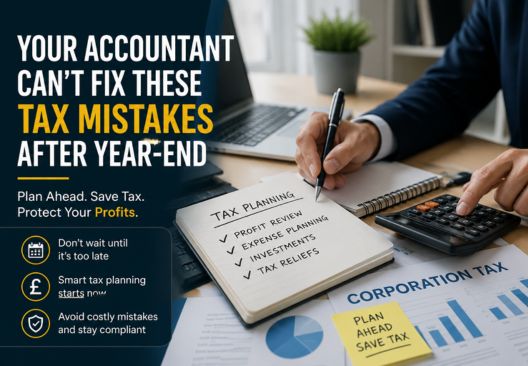
Corporation Tax Mistakes UK Businesses Make Before Year-End
Every January, we speak to business owners who ask the same question:
"Is there anything we can still do to reduce our corporation tax bill?"
Sometimes the answer is yes.
More often than not, the answer is frustratingly simple:
"We should have looked at this before the year-end."
That isn't because accountants don't want to help. It's because corporation tax planning works best before decisions are made, not after.
For UK limited companies, corporation tax remains one of the largest annual expenses. Companies with profits up to £50,000 generally pay 19%, while profits above £250,000 are taxed at 25%, with marginal relief applying between those thresholds.
- Yet the biggest tax mistakes we see rarely involve getting the rate wrong.
- They usually involve timing, planning, and missed opportunities.
Mistake 1: Assuming Tax Planning Starts When the Accounts Are Finished
Many directors believe tax planning happens after the accountant prepares the year-end accounts. In reality, that's when most of the planning opportunities have already passed.
If your financial year ended in March and you decide in June that you should have invested in new equipment, increased pension contributions, or reviewed your director remuneration strategy, those decisions may no longer affect the previous year's tax position.
By the time the accounts are complete, the story has largely been written.
The companies that manage tax efficiently are usually reviewing their numbers throughout the year rather than waiting for year-end surprises.
Mistake 2: Focusing on Tax Instead of Cash Flow
This may sound strange coming from a tax adviser, but many businesses focus too much on reducing tax and not enough on protecting cash flow.
A company can afford a large corporation tax bill if it has planned for it. The real problem occurs when directors don't know the bill is coming.
We've seen profitable businesses panic over tax liabilities not because the amount was unreasonable, but because no money had been set aside throughout the year.
Good tax planning isn't simply about paying less tax. It's about knowing what's coming and avoiding unpleasant surprises.
Mistake 3: Leaving Major Business Purchases Until After Year-End
A surprisingly common scenario looks something like this:
A business owner spends months discussing a new vehicle, software system, or piece of equipment.
The purchase is eventually approved.
Unfortunately, it happens two weeks after the financial year closes.
The investment still benefits the business operationally, but from a tax perspective the timing may not be as effective as it could have been.
This doesn't mean businesses should buy things purely to save tax.
However, understanding the tax implications before making large purchases often leads to better financial decisions.
Mistake 4: Ignoring the Marginal Relief Zone
Many directors understand the 19% small profits rate.
Many also understand the 25% main rate.
Where confusion usually starts is the area between them.
Businesses with profits between £50,000 and £250,000 may qualify for marginal relief, which creates a gradual transition between the two rates.
We've found that many growing companies pay attention to revenue, turnover and sales performance but rarely monitor where they sit from a corporation tax perspective.
A business generating £60,000 profit faces very different planning opportunities from one generating £240,000 profit.
Knowing where your company sits before year-end can influence investment decisions, profit extraction strategies and future budgeting.
Mistake 5: Treating Bookkeeping as an Administrative Task
Most directors don't start businesses because they enjoy bookkeeping.
Understandably, it often becomes something that gets pushed to the bottom of the priority list.
The problem is that poor bookkeeping doesn't just create compliance issues.
It creates blind spots.
If your records are six months behind, you don't really know how profitable the business is.
If you don't know how profitable the business is, forecasting tax becomes guesswork.
And when tax planning becomes guesswork, mistakes become expensive.
Accurate bookkeeping gives directors something far more valuable than compliance.
It gives clarity.
Mistake 6: Not Reviewing Director Remuneration Until It's Too Late
One of the most common questions limited company directors ask is:
"Should I take salary or dividends?"
The honest answer is that there is no universal formula.
The right approach depends on company profits, personal circumstances, future plans and tax objectives.
What matters is reviewing the strategy early enough.
Too often, directors wait until year-end before looking at how they've extracted profits from the business.
At that point, flexibility may be limited.
Regular reviews throughout the year usually produce better outcomes than last-minute decisions.
The Businesses That Usually Pay Less Tax
After working with limited companies across different industries, we've noticed a pattern.
The businesses that manage corporation tax most effectively aren't necessarily the ones with the most sophisticated structures.
They're the ones that plan earlier.
They review their numbers regularly.
They ask questions before making major decisions.
And they treat tax planning as an ongoing process rather than an annual exercise.
Final Thoughts
No accountant can go back and change decisions that were made six months ago.
That's why the most valuable tax advice often happens before year-end, not after it.
As your next accounting period progresses, don't wait until your accounts are ready to think about corporation tax.
Review your profits regularly.
Monitor your cash flow.
Understand where your company sits within the current corporation tax thresholds.
Most importantly, seek advice before important financial decisions are made.
Because when it comes to corporation tax, timing is often the difference between a missed opportunity and a smart business decision.
Frequently Asked Questions
-
Can an accountant reduce corporation tax after year-end?
An accountant can ensure all eligible reliefs and allowable expenses have been claimed correctly. However, many tax-planning opportunities depend on decisions made before the financial year ends. Once the year-end has passed, the scope for reducing corporation tax is often limited.
-
What tax planning should be done before year-end?
Business owners should review projected profits, planned investments, director remuneration, pension contributions, and cash flow forecasts before year-end. Early planning provides more opportunities to improve tax efficiency.
-
How can a limited company reduce corporation tax legally?
A limited company may reduce its corporation tax liability through allowable business expenses, pension contributions, capital allowances, R&D tax relief (where applicable), and strategic business planning. Professional advice can help identify the most suitable options.
-
What are the most common corporation tax mistakes?
Common mistakes include poor bookkeeping, failing to plan before year-end, overlooking allowable expenses, delaying major investments, and not forecasting future tax liabilities.
-
When should businesses start tax planning?
Ideally, tax planning should take place throughout the financial year. Many businesses review their position quarterly to identify opportunities before important financial decisions are made.
Recent Article