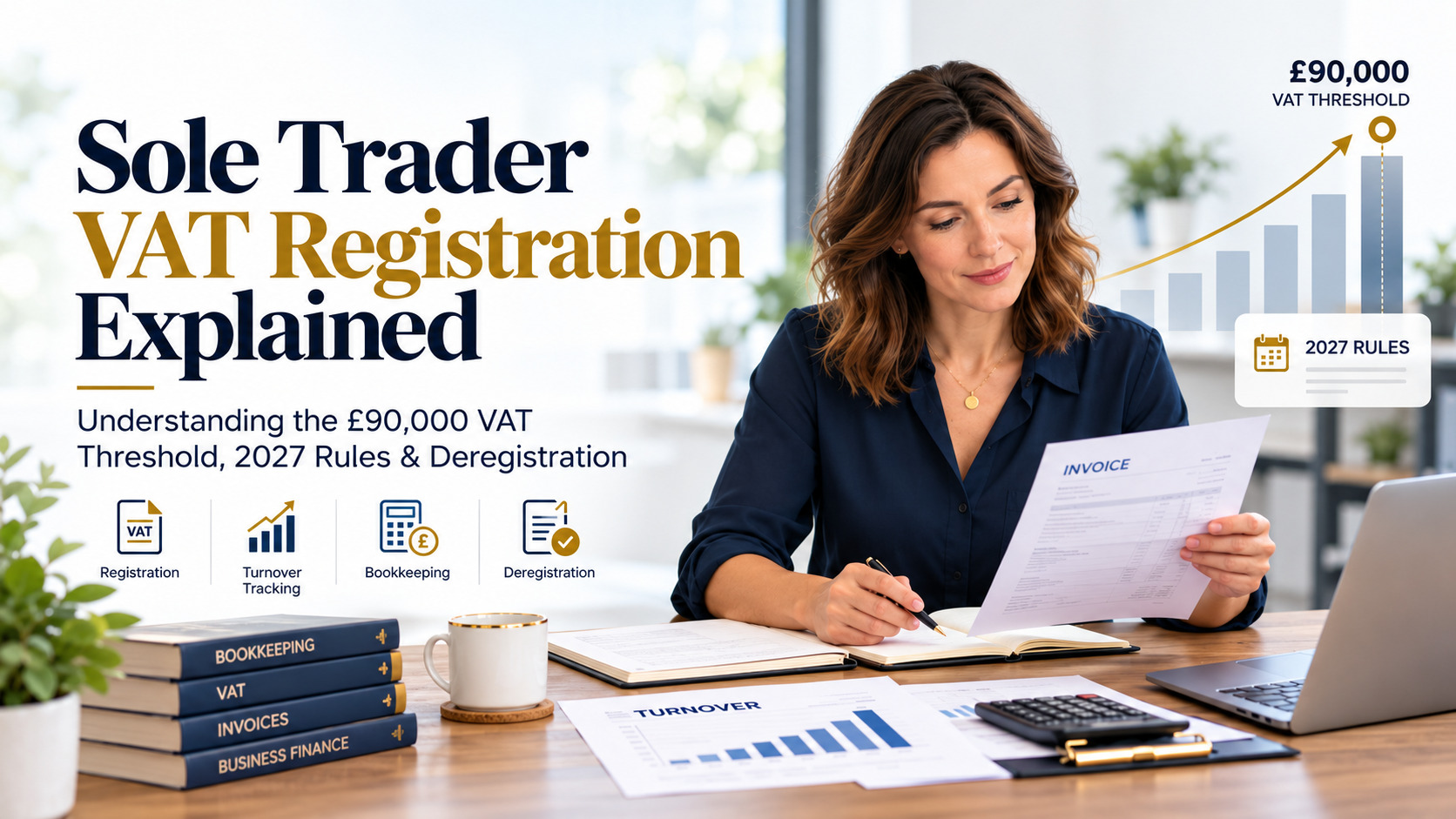
Sole Trader VAT Registration Explained
You can run a successful sole-trader business without charging VAT — until growth pushes your taxable turnover over the VAT registration threshold.
That is where many self-employed people become confused. Does VAT apply only to sales above £90,000? Is the threshold based on profit? Does it reset every April? And if VAT starts reducing your margins, can you simply deregister?
For UK sole traders, the key figure is taxable turnover, not profit. The compulsory VAT registration threshold is currently £90,000, and Budget 2026 has confirmed that it will remain £90,000 from April 2027.
This guide explains when a sole trader needs to register for VAT, how the rolling 12-month test works, what happens to your first £90,000 of turnover, how VAT differs from Income Tax and when VAT deregistration may be possible.
Do Sole Traders Need to Register for VAT?
Being a sole trader does not automatically mean you need to register for VAT.
Self-employment registration and VAT registration are separate HMRC obligations.
You generally need to register for VAT when either:
-
your taxable turnover for the previous 12 months goes over £90,000, or
-
you expect your taxable turnover to exceed £90,000 during the next 30 days alone.
HMRC also allows businesses below the compulsory threshold to register voluntarily.
If you are unsure how VAT registration works in practice, our VAT registration guide for small UK businesses explains the registration process and what happens afterwards.
What Does Taxable Turnover Mean?
Taxable turnover is not the same as profit.
It broadly includes the value of goods and services you sell that are not VAT-exempt or outside the scope of VAT. Standard-rated, reduced-rated and zero-rated sales can all count towards taxable turnover.
That means business expenses do not simply reduce your turnover for purposes of deciding whether the VAT registration threshold has been crossed.
Consider a sole trader with:
Sales: £96,000
Allowable business expenses: £38,000
Profit: £58,000
The £58,000 profit figure does not determine whether VAT registration is required.
The relevant VAT question starts with the £96,000 taxable turnover.
This is why accurate records matter. Our bookkeeping guide for small businesses explains how keeping current financial records helps business owners monitor VAT, expenses and other tax obligations before deadlines become urgent.
[EXPERT TIP: Once your rolling taxable turnover reaches around £70,000–£80,000, start reviewing it every month. Do not wait until your annual accounts or Self Assessment return is prepared.]
Do Sole Traders Pay VAT on the First £90,000?
This is one of the most misunderstood parts of VAT registration.
The £90,000 threshold is not a permanent VAT-free allowance that means your first £90,000 of sales each year can always be ignored.
Instead, it determines when compulsory VAT registration normally becomes necessary.
Once you become VAT registered, you generally need to apply the appropriate VAT treatment to taxable supplies from your effective date of registration. HMRC explains that businesses can start charging VAT and reclaiming eligible VAT on purchases from that effective date.
How Does the Rolling 12-Month VAT Threshold Work?
The VAT registration test does not simply run:
April to March,
January to December, or
your accounting year.
Instead, you need to look backwards over the previous 12 months on a rolling basis.
For example:
| Month | Rolling taxable turnover |
|---|---|
| June | £73,000 |
| July | £77,500 |
| August | £82,000 |
| September | £87,000 |
| October | £92,000 |
In this example, the business should not wait for its financial year to end.
HMRC says that if taxable turnover for the previous 12 months goes over £90,000, registration is normally required within 30 days of the end of the month in which the threshold was exceeded.
Example: A Sole Trader Growing Gradually
Suppose a self-employed marketing consultant has £84,000 of taxable turnover during the previous 12 months.
During the next month, they invoice another £9,000 while £2,000 of older turnover falls outside the rolling period.
The new rolling figure is:
£84,000 + £9,000 − £2,000 = £91,000
That should trigger an immediate review of the VAT registration position.
What if One Large Contract Pushes You Over?
There is also a forward-looking VAT test.
Suppose your previous 12-month turnover is only £55,000, but you sign a contract that will generate more than £90,000 of taxable turnover during the next 30 days alone.
You may need to register even though your historic turnover has not yet exceeded the threshold.
HMRC says the effective registration date in this situation is generally the date you first realised turnover would exceed the threshold during those 30 days.
Key takeaway: VAT registration is not something sole traders should check only once per year.
How Much Can a Sole Trader Earn Before Paying Tax in the UK?
VAT and Income Tax are often confused, but they work very differently.
For the 2026/27 tax year, the standard Personal Allowance is £12,570, although individual circumstances can affect the amount available. Budget 2026 also confirms a £12,570 Personal Allowance for 2027/28.
The VAT threshold, however, is £90,000 of taxable turnover.
These figures measure different things.
| Rule | What it measures |
|---|---|
| £90,000 VAT threshold | Taxable business turnover |
| £12,570 standard Personal Allowance | Income before Income Tax in standard circumstances |
| Business profit | Broadly, income less allowable business expenses for Income Tax purposes |
Imagine a sole trader has:
Turnover: £95,000
Allowable expenses: £40,000
Business profit: £55,000
For VAT, the £95,000 taxable turnover may be the critical figure.
For Income Tax, the calculation is based on taxable income/profit under the applicable Income Tax rules.
So asking:
“How much can a sole trader earn before paying VAT?”
and:
“How much can a sole trader earn before paying Income Tax?”
produces two completely different answers.
For wider self-employed accounting and tax support, see our accounting services for freelancers and sole traders.
Is Being VAT Registered Killing Your Business?
For some sole traders, VAT registration can create genuine commercial pressure.
This is particularly noticeable in business-to-consumer (B2C) industries where customers cannot normally reclaim VAT.
Suppose you currently sell a service for:
£120
After VAT registration, you may face two broad commercial choices.
You could increase the selling price to reflect VAT, potentially making the service more expensive for customers.
Alternatively, you may keep the final customer price at £120 and absorb the VAT element within the existing price, which can reduce your margin.
The correct approach depends on your market, customer type, pricing structure and ability to recover VAT on business costs.
B2B Businesses May Face a Different Situation
If most customers are VAT-registered businesses, the commercial impact can be different because eligible business customers may generally be able to recover VAT under the normal rules.
VAT registration may also allow your business to recover eligible VAT on qualifying purchases.
That means VAT registration is not automatically good or bad.
You need to look at:
customer type, pricing, margins, VAT-bearing expenses and cash flow.
HMRC provides a tool to help businesses estimate what VAT registration may mean for their circumstances.
Can a VAT Scheme Reduce the Administrative Pressure?
Potentially.
VAT-registered businesses may qualify for different accounting schemes.
The Flat Rate Scheme is available to eligible businesses with taxable turnover of £150,000 or less when joining.
The Cash Accounting Scheme can be available where estimated VAT taxable turnover is £1.35 million or less. Under cash accounting, VAT is generally paid to HMRC when customers pay rather than simply when invoices are issued, although there are specific eligibility and transaction rules.
The Annual Accounting Scheme may also be available to eligible businesses with taxable turnover of £1.35 million or less.
These schemes should not automatically be described as ways to “save tax”.
They mainly change how VAT is calculated, reported or paid, and the right choice depends on the business.
[EXPERT TIP: Before choosing a VAT scheme, model the numbers using your actual sales, VAT-bearing expenses, payment terms and customer profile. A scheme that improves cash flow for one sole trader may offer little benefit to another.]
Is the VAT Threshold Changing in 2027?
No increase has been announced for April 2027.
Budget 2026 confirms:
| VAT threshold | From April 2026 | From April 2027 |
|---|---|---|
| Registration threshold | £90,000 | £90,000 |
| Deregistration threshold | £88,000 | £88,000 |
So the VAT registration threshold for 2027 remains £90,000.
This is important for sole traders forecasting growth during 2027.
If your business is already generating turnover close to £90,000, do not assume the government will raise the threshold before you reach it.
Plan based on the confirmed £90,000 figure unless the rules change later.
What Is the VAT Deregistration Threshold?
The current VAT deregistration threshold is £88,000, and Budget 2026 confirms that it remains £88,000 from April 2027.
HMRC's current thresholds guidance states that a VAT-registered business whose taxable turnover falls below £88,000 may be able to cancel its VAT registration, subject to the relevant rules.
Notice that this is lower than the £90,000 registration threshold.
That distinction helps prevent businesses from continually entering and leaving the VAT system when turnover fluctuates around £90,000.
Can I Deregister Just Because VAT Is Hurting My Margins?
Not necessarily.
VAT deregistration is governed by eligibility rules.
Simply deciding that VAT is inconvenient or reducing your margin does not automatically mean you can cancel the registration.
If turnover has genuinely fallen and you expect taxable turnover to remain within the deregistration conditions, then deregistration may be worth reviewing.
Should a Sole Trader Register for VAT Voluntarily?
Possibly.
HMRC allows voluntary VAT registration when taxable turnover is below £90,000.
Voluntary registration can make sense where:
-
most customers are VAT-registered businesses;
-
you incur substantial VAT on business purchases;
-
you expect turnover to exceed £90,000 soon; or
-
VAT registration fits your wider commercial arrangements.
But it also creates additional compliance work.
Once registered, you may need to manage VAT invoices, digital records, VAT returns and payments to HMRC.
Do not register voluntarily simply because someone tells you it makes the business “look bigger”.
Review the financial impact first.
Frequently Asked Questions
Do I need to pay VAT as a sole trader in the UK?
Not automatically. A sole trader generally needs to register when taxable turnover exceeds the £90,000 compulsory threshold, or when the business expects to exceed £90,000 during the next 30 days alone. Voluntary registration is also possible below the threshold.
Do I pay VAT on the first £90,000 of turnover?
The £90,000 figure is a registration threshold, not a recurring VAT-free allowance. Once VAT registration takes effect, the appropriate VAT treatment generally applies to taxable supplies from the effective registration date.
What is the VAT threshold for sole traders in 2026?
The compulsory UK VAT registration threshold is £90,000 of taxable turnover.
What is the sole trader VAT threshold for 2027?
Budget 2026 confirms that the VAT registration threshold will remain £90,000 from April 2027.
What is the VAT deregistration threshold?
The VAT deregistration threshold is £88,000, and this remains the confirmed threshold from April 2027.
Is VAT based on turnover or profit?
VAT registration is based on taxable turnover, not business profit.
Approaching the VAT Threshold? Plan Before You Cross It
For a growing sole trader, VAT registration should not arrive as a surprise.
The most important habit is to monitor your rolling 12-month taxable turnover, particularly once sales begin approaching £90,000.
That gives you time to review prices, customer contracts, VAT schemes, bookkeeping and cash flow before compulsory registration becomes urgent.
TaxVATReturn supports sole traders and freelancers with VAT, bookkeeping, Self Assessment and wider accounting requirements. You can learn more about our sole trader and freelancer accounting support or review our VAT registration guide if your turnover is approaching the threshold.
Speak with TaxVATReturn before VAT becomes a last-minute problem.
Recent Article