
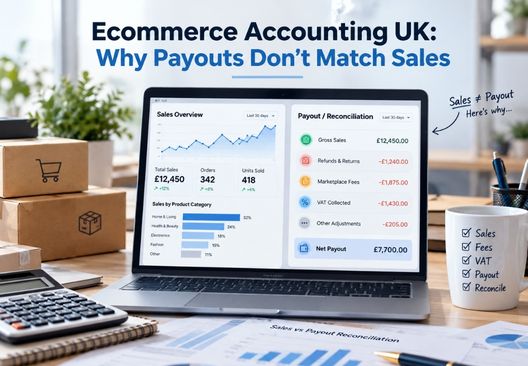
Ecommerce Accounting UK: Why Payouts Don’t Match Sales
A £20,000 payment from Amazon, Shopify or another marketplace does not necessarily mean your business made £20,000 of sales.
That sounds obvious once it is explained. Yet this is one of the areas where e-commerce bookkeeping can become misleading very quickly.
Marketplaces can deduct fees, advertising costs, refunds, fulfilment charges and other amounts before transferring money to your bank account. Some platforms may also hold reserves or delay part of a settlement.
If the business simply records the amount received in the bank as sales, the accounts can become distorted.
Direct answer: E-commerce businesses should normally reconcile marketplace sales separately from the net cash deposited into the bank. Gross customer sales, refunds, marketplace fees, VAT, reserves and other deductions should be identified individually so the accounting records show what the business actually sold, what it spent and what cash it ultimately received.
This is one reason specialist e-commerce accounting support can become more important as an online business grows.
Why Ecommerce Sales and Bank Payouts Are Different
Consider a simplified example.
An online seller records £50,000 of customer orders during a month.
The marketplace then deducts:
| Transaction | Amount |
|---|---|
| Customer sales | £50,000 |
| Customer refunds | -£3,000 |
| Marketplace fees | -£5,500 |
| Advertising charges | -£2,000 |
| Fulfilment charges | -£3,500 |
| Temporary reserve | -£1,000 |
| Amount transferred to bank | £35,000 |
If the bookkeeper records only the £35,000 bank deposit as revenue, the accounts are not showing what actually happened.
The business generated £50,000 of gross customer sales.
It also incurred several different costs and adjustments.
Those figures matter because management decisions, VAT calculations and profitability analysis may all depend on the underlying transactions rather than the final bank settlement.
This is fundamentally different from a traditional business where one customer invoice may produce one matching bank receipt.
Why This Matters for VAT
The difference between marketplace sales and payouts becomes particularly important for VAT-registered e-commerce businesses.
HMRC requires VAT-registered businesses to keep records of what they buy and sell, invoices, credit notes and other relevant transactions. Certain VAT records must also be maintained digitally under Making Tax Digital rules.
Your VAT position therefore cannot simply be reconstructed from the amount that Amazon, Shopify or another platform transferred to your bank.
Suppose a platform collects £12,000 from customers but transfers £8,500 after deducting fees and refunds.
The VAT treatment needs to reflect the underlying taxable transactions.
The £8,500 bank receipt does not automatically tell you:
- the value of taxable sales
- how much output VAT arose
- whether refunds reduced the VAT position
- whether platform fees included recoverable VAT
- whether import VAT or reverse-charge transactions need consideration
That information comes from the transaction records.
[EXPERT TIP: Treat the marketplace settlement report as a reconciliation document, not as a substitute for your sales records.]
The Bank Reconciliation Can Be Correct While the Accounts Are Wrong
This is an important distinction.
Imagine your accounting software shows:
Bank deposit: £35,000
And your actual bank statement also shows:
£35,000 received
The bank account reconciles perfectly.
That still does not prove that revenue has been recorded correctly.
If £50,000 of sales has been reduced to £35,000 before reaching the bank, recording only £35,000 as revenue could understate both turnover and the associated costs.
That can affect:
gross margin
VAT reporting
management accounts
Corporation Tax calculations
stock analysis
business valuations
cash-flow forecasting
Good e-commerce bookkeeping therefore needs two separate reconciliations:
What happened on the marketplace?
and
What eventually reached the bank?
Both need to agree.
Refunds Are Not Just Negative Sales
Returns are a normal part of online retail.
But they create accounting complexity because the timing of:
customer order → sale → refund → marketplace adjustment → bank settlement
may span different days or even different accounting periods.
An e-commerce business with substantial returns should be able to answer:
How much did we sell?
How much was refunded?
Which products are generating the highest return rates?
Has the related VAT treatment been adjusted correctly?
How much did refunds reduce our real margin?
If refunds are simply buried inside net platform payouts, management loses useful information.
A company could appear to be growing because gross order volume is increasing while profitability is actually falling because refund rates are rising.
Marketplace Fees Need Their Own Accounting Treatment
Amazon fees, Shopify charges, payment-processing costs, fulfilment fees and advertising costs are not the same thing as reduced sales.
They are generally business costs that should be separately visible.
Why does that matter?
Because an owner looking only at revenue may see:
£100,000 monthly sales
and conclude that the business is performing strongly.
But suppose the business also has:
£15,000 marketplace and payment fees
£12,000 advertising spend
£10,000 fulfilment costs
£40,000 product cost
The commercial picture becomes very different.
This is why good bookkeeping should help an e-commerce business understand its economics, rather than simply produce figures for the year-end accounts.
Gross Margin Is More Useful Than Revenue Alone
E-commerce businesses often focus heavily on revenue.
Revenue is easy to see.
Amazon shows sales. Shopify shows orders. Advertising platforms show revenue attributed to campaigns.
But directors should also understand what remains after the direct costs associated with those sales.
A business growing from £80,000 to £120,000 of monthly sales can still become financially weaker if:
product costs rise
marketplace fees increase
discounting becomes heavier
refund rates increase
advertising becomes less efficient
fulfilment costs grow
That is why e-commerce accounting should produce information that helps owners understand margin, not just turnover.
A simple commercial view could look like this:
| Metric | Month 1 | Month 2 |
|---|---|---|
| Revenue | £80,000 | £110,000 |
| Product cost | £32,000 | £48,000 |
| Marketplace/processing fees | £8,000 | £13,000 |
| Fulfilment | £6,000 | £10,000 |
| Advertising | £10,000 | £18,000 |
| Contribution remaining | £24,000 | £21,000 |
Sales increased by £30,000.
But the amount remaining after these costs actually fell by £3,000.
A business looking only at sales could celebrate.
A business looking at its accounting data would ask what changed.
Selling on More Platforms Makes Reconciliation Harder
A business may begin with one Shopify store.
Later it adds:
Amazon
eBay
Etsy
TikTok Shop
another Shopify store
international websites
PayPal
Stripe
Klarna
Growth is positive, but every new platform introduces another source of transaction data.
You then need to prevent:
duplicate sales
missing orders
incorrect refunds
duplicate fees
incorrect VAT coding
unmatched settlements
The problem becomes particularly noticeable when the company tries to compare its accounting software with the bank.
One platform may pay every day.
Another may settle weekly.
Another may retain reserves.
Payment processors may deduct their charges before remitting the balance.
The accounts therefore need a controlled process rather than manual assumptions.
What About Online Marketplace Reporting to HMRC?
Online sellers should also be aware that digital platforms have reporting obligations.
UK rules introduced from 1 January 2024 mean some digital platform operators may need to collect and verify information about sellers and report specified information to HMRC. Sellers may also receive copies of information reported about them.
This does not create a new tax simply because someone sells online.
But it reinforces an important point:
Your own accounting records should be capable of explaining the business activity being reported through online platforms.
If platform information shows significant sales while your accounts show materially different turnover, you should be able to explain the reconciliation.
That is much easier when marketplace transactions are properly recorded throughout the year.
Ecommerce VAT Can Become More Complex Across Borders
Businesses selling goods through online marketplaces can also face different VAT treatments depending on factors such as where goods are located, where customers are located and whether transactions take place through an online marketplace.
HMRC has separate guidance covering goods sold to UK customers through online marketplaces and how VAT obligations can differ according to the transaction circumstances.
This is particularly relevant when an online business begins importing inventory or expanding internationally.
The accounting system may need to deal with:
import VAT
customs documentation
overseas supplier invoices
marketplace VAT adjustments
cross-border sales
foreign currencies
At that point, bookkeeping that was perfectly adequate for a £5,000-per-month online store may no longer be suitable for a £100,000-per-month multi-channel business.
[EXPERT TIP: Review your accounting process whenever you add a new marketplace, country, fulfilment arrangement or payment provider. Complexity usually grows before the accounting problems become visible.]
Five Numbers an Ecommerce Owner Should Review Every Month
Rather than waiting for the annual accounts, I would want an online seller to understand at least these five numbers regularly:
1. True sales revenue
Not simply marketplace payouts.
2. Gross margin
What remains after the direct cost of the products sold?
3. Marketplace and payment fees
How much of every pound of revenue is being taken by platforms and processors?
4. Refund rate
Are returns increasing faster than sales?
5. VAT and tax liabilities
How much of today's bank balance is already committed to future tax payments?
These figures turn bookkeeping into management information.
That is where professional ecommerce accountants should add value beyond filing annual accounts.
When Does an Ecommerce Business Need an Accountant?
There is no turnover figure where every online seller suddenly requires specialist accounting support.
A small store with one marketplace and clean records may remain relatively straightforward.
But professional support becomes increasingly valuable when:
sales are spread across several platforms
VAT registration becomes relevant
stock levels become significant
the business imports products
marketplace settlements no longer reconcile easily
refund volumes increase
international sales begin
management cannot confidently calculate product margins
The warning sign is usually not business size.
It is when the owner can no longer answer confidently:
“How did the sales shown by my platforms become the figures shown in my accounts?”
If answering that question requires several spreadsheets and guesswork, the accounting system needs attention.
Ecommerce Accounting Should Explain the Business
The objective of e-commerce accounting should not simply be to submit accounts and tax returns.
The records should explain the commercial reality of the business.
An owner should be able to understand:
what was sold
what was refunded
what the marketplaces charged
what products cost
how much VAT is due
how much cash is actually available
whether margins are improving
When those numbers are visible, decisions about advertising, stock purchases, pricing and growth become much stronger.
When they are not visible, a fast-growing online business can make important decisions using misleading figures.
If you sell through Amazon, Shopify, eBay or other online marketplaces and need clearer bookkeeping, VAT or financial reporting, see our e-commerce accounting services.
TaxVATReturn can help online businesses build cleaner records and better visibility over the numbers behind their marketplace sales.
01284 332375
info@taxvatreturn.co.uk
TaxVATReturn
FAQs
Why does my Amazon or Shopify payout not match my sales?
Platforms can deduct refunds, fees, advertising charges, fulfilment costs and other adjustments before sending money to your bank. The settlement therefore represents net cash movement rather than necessarily representing gross sales.
Should ecommerce marketplace payouts be recorded as revenue?
Not automatically. The underlying customer transactions, fees, refunds and other deductions need to be understood so that sales and expenses are recorded correctly.
Do ecommerce businesses need to keep digital VAT records?
VAT-registered businesses generally need to keep specified VAT records digitally under Making Tax Digital unless an exemption applies. HMRC requires records covering sales, purchases, adjustments and other VAT information.
Why use an ecommerce accountant instead of a general accountant?
The main difference is familiarity with marketplace settlements, payment processors, multi-channel reconciliation, stock, refunds, platform fees and e-commerce VAT issues. The value is greatest where those areas materially affect the accuracy of the accounts.
Recent Article