HMRC MTD Sign-Up Letters: What You Need to Do
For thousands of sole traders and landlords, Making Tax Digital for Income Tax is about to become much harder to ignore.
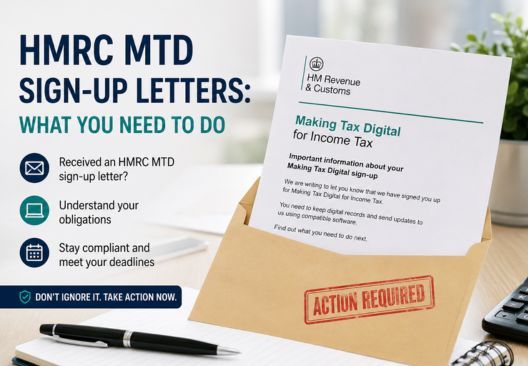
HMRC has confirmed that from September 2026 it will begin signing up taxpayers who should already be using Making Tax Digital (MTD) for Income Tax but have not yet registered themselves. The process will take place in stages, and HMRC says further guidance will be published in late August for people who receive a letter telling them they have been signed up.
That announcement is important, but there is one point that could easily be misunderstood:
HMRC signing you up does not mean HMRC has completed your MTD obligations for you.
You may still need to bring several months of digital records up to date, choose or authorise compatible software, check that HMRC has the correct income sources on your account and submit quarterly updates that are already due.
For someone who has been putting MTD off because they were unsure whether the rules applied, a letter from HMRC could therefore create more questions than answers.
This guide explains what an HMRC MTD sign-up letter means, why HMRC is now taking action, what you should check before responding and what to do if you believe HMRC has included you incorrectly.
Why Is HMRC Automatically Signing People Up for MTD?
Making Tax Digital for Income Tax became mandatory on 6 April 2026 for sole traders and landlords whose qualifying income from self-employment and property exceeded £50,000 in the relevant tax year.
The transition is already well underway. HMRC reported on 12 August that more than 436,000 sole traders and landlords had submitted their first quarterly update, while more than 570,000 taxpayers had signed up for the service. HMRC is now turning its attention to taxpayers who appear to be within the mandatory regime but have still not registered.
From September, HMRC intends to start signing those taxpayers up itself.
This is not simply an administrative exercise. HMRC is effectively moving the first phase of MTD from “you need to register” towards “if you should be in the system, we are going to bring you into it.”
If you are unsure how the wider system works, our guide to Making Tax Digital for UK businesses explains the underlying rules, reporting requirements and rollout dates.
For taxpayers who already know they should be using MTD, however, the more urgent question is no longer what MTD is. It is whether their records and reporting are actually up to date.
Received an HMRC MTD Letter? Do Not Assume Everything Is Sorted
An HMRC letter saying you have been signed up may sound as though the difficult part has been handled for you.
It has not.
Making Tax Digital is fundamentally a digital record-keeping and reporting system. Taxpayers within the regime need compatible software to create, store and correct digital records, send quarterly information to HMRC and ultimately complete their annual Income Tax reporting.
So if HMRC signs you up, you should immediately establish where you stand.
Have you been keeping your business or property records digitally since April? Is your accounting software compatible with MTD for Income Tax? Does your software contain all income and expenses from the beginning of the tax year? Was your first quarterly update submitted? Are all of the self-employment and property income sources attached to your MTD account correct?
These questions matter more than the registration itself.
A taxpayer could technically be signed up for MTD while still being months behind with bookkeeping. That is why automatic registration should never be confused with automatic compliance.
If your records are behind, professional bookkeeping services can help bring the figures together before another reporting deadline arrives.
Are You Actually Required to Use MTD in 2026?
Before doing anything else, check that HMRC is applying the correct threshold to you.
For the 2026/27 tax year, mandatory MTD for Income Tax applies to qualifying sole traders and landlords whose qualifying income for 2024/25 was more than £50,000. From April 2027, the threshold falls to more than £30,000 based on qualifying income for 2025/26, and from April 2028 it falls to more than £20,000 based on qualifying income for 2026/27.
The word “income” causes one of the biggest misunderstandings.
HMRC defines qualifying income as your combined gross income from self-employment and property before expenses are deducted. It is not your taxable profit.
Suppose a self-employed consultant generated £62,000 in turnover but had £24,000 of legitimate business expenses. Their profit might be only £38,000, but that does not automatically put them below the MTD threshold because HMRC is looking at qualifying income before those expenses.
A landlord can face the same issue. Rental income may exceed the threshold even though mortgage costs, repairs, agent fees and other expenses substantially reduce the final taxable profit.
This distinction is one reason some taxpayers may receive an HMRC MTD letter even though they believed their income was below £50,000.
What If You Did Not Receive an Earlier HMRC Letter?
You should not use that as proof that MTD does not apply to you.
HMRC says it reviews Self Assessment returns to identify taxpayers who are above the relevant qualifying-income threshold and normally writes to them before they are required to start MTD. However, HMRC also makes clear that it remains the taxpayer's responsibility to check whether MTD applies even if no letter was received.
That creates a potentially uncomfortable situation for someone who assumed:
“HMRC never contacted me, so I must not be affected.”
If your 2024/25 qualifying income was above £50,000, it is worth checking your position now rather than waiting for September.
This is particularly important where you have more than one source of qualifying income. Someone might have £38,000 of sole-trader turnover and £18,000 of gross property income, for example. Looking at either income stream separately could give the wrong impression because qualifying self-employment and property income can be combined when determining whether the threshold is exceeded.
For landlords who need broader help with rental accounts and tax reporting, our landlord accounting services provide support with property income, Self Assessment and ongoing compliance.
What If You Missed the First MTD Quarterly Update?
This is where the timing of HMRC's September action becomes particularly relevant.
The first quarterly update deadline for the 2026/27 tax year was 7 August 2026. The next deadlines are 7 November, 7 February and 7 May.
If you missed the August deadline, there is an important first-year concession: HMRC will not issue penalty points for late quarterly updates during 2026/27. But the requirement itself has not disappeared. You still need to maintain digital records and send the necessary quarterly updates before you can submit your tax return.
That difference matters.
“No penalty points this year” does not mean “the quarterly update is optional.”
If your first update is outstanding, use the breathing space HMRC has provided to correct the position before the second deadline arrives. Allowing six months of bookkeeping to accumulate could make the November update much more difficult than it needs to be.
You should also remember that the normal Self Assessment deadline remains relevant. Quarterly updates do not replace the annual tax return, and HMRC has confirmed that penalties can still apply for late tax returns and late tax payments.
If you need help with your annual filing as well as MTD, see our Self Assessment Tax Return services.
What Should You Do Before HMRC Signs You Up?
If you already know that your qualifying income placed you within MTD from April 2026, there is a strong argument for dealing with the position yourself rather than waiting for HMRC.
HMRC is actively encouraging affected taxpayers to sign up before the automatic process starts. According to HMRC, registering yourself gives you an opportunity to make sure your MTD details are correct and prepare at your own pace rather than being brought into the system later.
This is where a sensible review becomes more valuable than simply rushing through a registration form.
Check your 2024/25 qualifying income. Confirm every relevant self-employment and property income source. Make sure your chosen software is compatible with MTD for Income Tax. Review your digital records from April onwards. Identify any missing income or expense transactions. Then check whether the first quarterly update has already been submitted successfully.
HMRC recommends choosing compatible software before signing up, because the software is what you will use to maintain records and communicate the required information to HMRC.
If you already use software for MTD for VAT, do not automatically assume the same setup covers Income Tax. HMRC specifically advises VAT-registered businesses to check whether their current software is also compatible with MTD for Income Tax.
What If HMRC Has Signed You Up but You Think It Is Wrong?
Do not ignore the letter.
Instead, establish why HMRC believes you are within MTD.
Start by looking at the qualifying income reported on your 2024/25 Self Assessment return. Remember that the relevant figure is gross qualifying income from self-employment and property before expenses, not simply the profit on which you eventually paid tax.
If you still believe MTD should not apply, HMRC's guidance says you should contact HMRC if you disagree with its decision that you need to use the system.
There are also exemptions in certain circumstances. For example, HMRC provides a digital-exclusion exemption where it would not be reasonable for a taxpayer to use compatible software to keep digital records and make the required submissions. Eligibility depends on the taxpayer's circumstances rather than simply preferring paper records.
A disagreement over whether MTD applies is therefore something to resolve, not something to leave unanswered.
The Bigger Issue Is Your Records, Not the Letter
The HMRC sign-up campaign may attract attention because receiving a tax letter naturally feels urgent. But for many taxpayers, the actual problem will have started months before the envelope arrives.
MTD is exposing a weakness that has existed in many small businesses for years: financial records are often only properly reviewed when the Self Assessment deadline is approaching.
That approach becomes far less practical when reporting takes place throughout the year.
A landlord who waits until January to organise twelve months of rental transactions may have managed under the traditional Self Assessment routine. Under MTD, poor record-keeping becomes visible much sooner because digital information feeds quarterly reporting.
The same applies to sole traders who mix personal and business transactions, fail to reconcile bank accounts, keep incomplete expense records or leave invoices outside their bookkeeping system.
MTD therefore should not be viewed simply as four extra HMRC deadlines.
The businesses that adapt best will be those that change the underlying process: maintain cleaner records throughout the year, review them regularly and treat quarterly reporting as the output of good bookkeeping rather than a separate administrative emergency.
Will MTD Penalties Become More Important After 2026/27?
Yes.
The first-year concession is temporary. HMRC says no penalty points will be issued for late quarterly updates during 2026/27. From 6 April 2027, the points-based system applies to quarterly MTD obligations. One penalty point can be added for each missed quarterly deadline, and after reaching four points a £200 fixed penalty can apply. Additional missed deadlines while at the threshold can lead to further £200 penalties.
We have explained the wider system in our guide to HMRC's penalty points system.
This makes the current tax year valuable preparation time.
If the first quarterly update exposed problems with your records, software or reporting process, fixing those problems now is more useful than simply celebrating the fact that no penalty point was issued.
Do You Need an Accountant for an HMRC MTD Letter?
Not everyone who receives an HMRC MTD letter will need an accountant simply to understand it.
But professional help becomes much more useful where the underlying position is unclear.
You may have multiple businesses, rental properties as well as self-employment income, incomplete records, an outstanding quarterly update, uncertainty over the £50,000 threshold or concerns that HMRC has signed you up incorrectly.
In those situations, the real job is not reading the letter. It is establishing the correct tax position and making sure the records behind your future submissions are reliable.
At TaxVATReturn, we work with sole traders and landlords across the UK on digital bookkeeping, Making Tax Digital and Self Assessment. Our role is not simply to send another quarterly figure to HMRC. We help ensure that the records behind those figures are organised, the right income sources are being reported and your annual tax obligations remain connected to the quarterly MTD process.
HMRC Is Taking the Next Step. Make Sure You Are Ready.
More than 436,000 taxpayers have already completed their first MTD quarterly update. HMRC's decision to begin signing up remaining taxpayers from September shows that the rollout is moving into a more active stage.
If you know MTD applies to you, there is little benefit in waiting for HMRC to take the first step.
And if you receive an HMRC MTD sign-up letter, do not treat it simply as another piece of tax correspondence. Check why you have been included, make sure your qualifying income has been assessed correctly, confirm that your digital records are complete and identify whether any quarterly reporting is outstanding.
The most important question is not whether HMRC has signed you up.
It is whether you are actually ready to comply once they do.
Received an HMRC MTD letter or unsure whether you should have been using Making Tax Digital since April 2026? Contact TaxVATReturn on 01284 332375 or email info@taxvatreturn.co.uk for professional support with MTD, digital bookkeeping and Self Assessment.
This article is for general information only and reflects HMRC guidance available on 18 August 2026. Individual tax circumstances vary, and professional advice should be obtained where appropriate.
Recent Article