HMRC VAT & PAYE Direct Debit: What Could Change?
HMRC is considering a change that could remove an everyday choice millions of businesses currently take for granted: how they pay their VAT and PAYE bills.
The government consultation published in June 2026 proposes making Direct Debit the required payment method for most VAT and PAYE return liabilities. The consultation closed on 16 August 2026, and the government will now use the responses to shape any future rules. Nothing has yet changed for businesses, but HMRC's own impact assessment suggests that approximately 2.4 million employers, sole traders and companies could ultimately be affected if the proposal goes ahead.
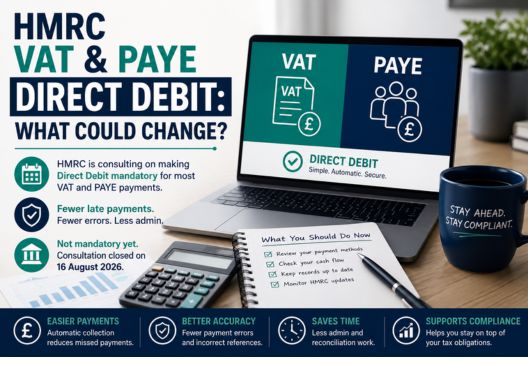
HMRC has not yet made Direct Debit mandatory for all VAT and PAYE payments. The government has consulted on requiring most businesses to use Direct Debit to reduce late payments, incorrect payment references and manual administration. Existing payment methods remain available for now, while HMRC considers safeguards, exemptions and possible enforcement measures before any final policy is introduced.
That distinction is important. Businesses do not need to change their payment process today simply because a consultation has taken place. They do, however, need to understand what is being proposed, because a mandatory Direct Debit system could affect cash-flow planning, payroll processes and the way VAT liabilities are managed.
Is HMRC Making Direct Debit Mandatory for VAT and PAYE?
Not yet.
The consultation is part of the government's wider Tax Update 2026 programme, which is focused on simplifying and modernising the tax system. HMRC has asked for views on making Direct Debit the required method for paying most VAT and PAYE return liabilities, subject to appropriate exceptions.
The policy has therefore moved beyond a vague idea: HMRC is actively considering how a mandatory system could work. But consultation is not the same as legislation. Businesses should continue using the payment options currently permitted until HMRC formally announces otherwise.
The government has said that it will publish a summary of responses following the consultation, and those responses will inform the implementation and scope of any future change.
For VAT-registered businesses, this is also another reason to make sure the wider VAT process is already working properly. If your registration, filing or record-keeping needs attention, our VAT registration guide for UK small businesses explains the fundamentals.
Why Does HMRC Want Businesses to Pay by Direct Debit?
The proposal is not primarily about businesses refusing to pay their taxes.
HMRC's own analysis says that when VAT or PAYE returns are filed on time but the associated payment arrives late, the cause is often oversight or a payment being allocated incorrectly, rather than an inability or unwillingness to pay. Businesses using manual methods need to remember the deadline, initiate the transaction and use the correct reference each time.
That creates several opportunities for avoidable mistakes.
A payment may be initiated a day late. The wrong PAYE reference could be entered. A VAT payment could be allocated to the wrong period. Someone responsible for approving payments could be absent when the deadline arrives.
Direct Debit removes much of that manual activity. Once the arrangement has been established, HMRC can collect the liability generated from the relevant return automatically.
This is why the government describes mandatory Direct Debit as part of a “right first time” approach to tax collection: fewer missed payments, fewer incorrect references and less administrative follow-up.
[EXPERT TIP: Automating the payment does not automate the accuracy of the underlying tax return. A perfectly executed Direct Debit can still collect the wrong amount if VAT or payroll records are incorrect.]
That is where reliable bookkeeping continues to matter. Businesses that need to strengthen their records can start with our guide to bookkeeping services for small businesses.
How Do Businesses Pay VAT and PAYE Today?
Businesses currently have considerably more flexibility than the proposed system would provide.
VAT and PAYE can already be paid by Direct Debit, but HMRC also accepts several alternative electronic methods.
| Payment Area | Current Position | Proposed Direction |
|---|---|---|
| VAT | Direct Debit, bank transfer, online banking, debit/corporate card and certain other methods | Direct Debit could become the required/default method |
| PAYE | Direct Debit, Faster Payments, Bacs, CHAPS, cards and other approved methods | Most employers could be required to use Direct Debit |
| Manual payment references | Often required | Reduced through automatic collection |
| Exceptions | Multiple payment options available | Alternative arrangements likely for qualifying exceptions |
| Large payments | Alternative electronic methods available | Payments above Direct Debit limits expected to remain excepted |
VAT Direct Debits are currently collected automatically after the return is submitted, generally three working days after the payment deadline. PAYE Direct Debits are normally collected shortly after the 22nd of the month or, where a return is filed after the 19th, four working days after filing.
Businesses using manual methods retain greater control over exactly when they initiate their payment. That flexibility is one reason some businesses may be reluctant to move to mandatory Direct Debit.
Could Mandatory Direct Debit Affect Business Cash Flow?
This is where the proposal becomes more important than it first appears.
For a business with predictable monthly payroll and healthy cash reserves, automatic PAYE collection may simply remove an administrative task. For businesses operating on tighter margins or experiencing seasonal revenue, however, the timing of a large automatic withdrawal can matter considerably.
Consider a VAT-registered business awaiting payment from several major customers. Its VAT return may show £18,000 payable even though those customers have not yet settled their invoices. Under the current system, the owner knows exactly when the payment will be initiated and can manage available funds around the deadline.
Under a fully automated arrangement, the focus shifts from remembering to make the payment to making sure sufficient cash is available when HMRC collects it.
The consultation specifically acknowledges potential issues around cash-flow management, banking constraints and changes to existing accounting processes. HMRC has asked businesses to provide evidence about these practical barriers before the policy is finalised.
This makes cash-flow forecasting more important, not less.
Direct Debit may reduce missed-payment risk, but it cannot solve an underlying shortage of working capital.
Could Some Businesses Be Exempt?
Almost certainly, if the proposal proceeds—but the final exemption rules have not yet been decided.
The UK Direct Debit system generally requires a compatible UK bank account, so businesses without one cannot currently use the payment method. HMRC's consultation acknowledges that this would need to be addressed.
There is also a technical payment limit. The BACS Direct Debit scheme has a £20 million transaction limit, so payments above the relevant threshold would need to use another method.
For PAYE, HMRC has also suggested that exceptions may need to cover people who are digitally excluded for reasons such as disability, age, religious belief or remote location.
The consultation therefore does not propose a simplistic system where every taxpayer, regardless of circumstances, is forced through the same payment process.
The challenge will be deciding who qualifies for an exception and how easy that exception is to obtain.
What Could Change Specifically for VAT Payments?
VAT is already heavily digitalised because Making Tax Digital requires most VAT-registered businesses to keep digital records and submit returns using compatible software.
Payment, however, is still separate from that reporting process.
HMRC is considering whether the final step should also become automated.
The attraction is obvious: submit the VAT return, and the resulting liability can be collected without someone separately entering bank details, copying a VAT number or scheduling a transfer.
But there are more complex businesses to consider. VAT Payments on Account apply to businesses with annual VAT liabilities above £2.3 million, and the existing Direct Debit system cannot currently handle those instalments in the standard way. HMRC is therefore considering how such businesses might fit into a future system.
For businesses already adapting their systems to digital reporting, our Making Tax Digital guide for UK businesses explains how HMRC's wider digital strategy is changing record-keeping and tax administration.
What Could Change for Employers Paying PAYE?
PAYE may be one of the areas where automation has the clearest administrative benefit.
Employers currently send payroll information to HMRC through Real Time Information (RTI), and HMRC can already use that information to determine the amount collected where a PAYE Direct Debit is active.
But the majority of PAYE payments are still made through other electronic methods such as Faster Payments, Bacs, CHAPS or online card payments, which means someone must initiate the transaction every month or quarter.
Mandatory Direct Debit could therefore create a more connected process:
-
Payroll is processed.
-
RTI information is submitted.
-
HMRC calculates the amount to collect.
-
The business is notified of the amount and collection date.
-
The PAYE liability is collected automatically.
HMRC currently tells employers using PAYE Direct Debit the collection date and amount at least three working days before taking the payment.
For employers managing multiple payroll obligations, that could reduce administration. But it also places greater importance on ensuring payroll submissions are correct before HMRC uses them to determine the payment.
Could HMRC Penalise Businesses That Refuse to Use Direct Debit?
This is being considered, but no new penalty has been introduced yet.
The consultation explores two possible approaches.
One is a penalty for businesses required to use Direct Debit that instead pay through another method—even where the underlying tax is paid fully and on time.
The second is using payment deadlines as an incentive. For example, electronic PAYE payments currently benefit from a later deadline than cheque payments, and electronic VAT payments can benefit from existing timing arrangements. HMRC is considering whether some of those benefits should only apply to Direct Debit users.
Those ideas are consultation options, not current rules.
Businesses should therefore be careful with headlines suggesting HMRC is already going to fine companies for paying VAT by bank transfer. That is not the present position.
If you want to understand how HMRC is changing its wider approach to compliance, our article on the HMRC penalty points system provides useful context.
[EXPERT TIP: Do not change a reliable tax-payment process because of a proposal. Continue meeting today's VAT and PAYE deadlines while preparing your systems for the possibility of future Direct Debit requirements.]
Will Mandatory Direct Debit Make Tax Compliance Easier?
For many businesses, probably.
Removing repetitive payment administration can reduce the chances of simple human error. HMRC also expects businesses to spend less time correcting incorrectly allocated payments, dealing with late-payment correspondence or appealing charges caused by administrative mistakes.
But automation creates a different type of responsibility.
The business must have:
-
accurate VAT and payroll records
-
enough money in the relevant account when payment is collected
-
reliable bank-account information
-
properly reconciled accounting records
-
processes for dealing with unexpected or disputed liabilities
In other words, Direct Debit simplifies the payment mechanism, not the entire tax-compliance process.
This is similar to the shift happening elsewhere in the tax system. More information is being reported digitally, more processes are being automated and HMRC increasingly wants businesses to deal with tax obligations closer to real time.
What Should UK Businesses Do Now?
There is no reason to panic or make unnecessary changes.
Instead, use the consultation as an opportunity to review whether your existing tax-payment process is strong enough to cope with greater automation.
First, confirm who is responsible for approving and monitoring VAT and PAYE payments. Review whether HMRC liabilities are reconciled against your accounts before payment. Make sure there is sufficient visibility over cash flow before major tax deadlines. And if Direct Debit already suits your business, consider whether voluntarily using it now could reduce manual administration.
Businesses should also keep an eye on HMRC's consultation response before making assumptions about exemptions, start dates or enforcement.
If your problem is not the payment method but unpredictable tax bills, our Self Assessment Payment on Account guide explains another area where better forecasting can prevent cash-flow surprises.
What Happens Next With the HMRC Direct Debit Proposal?
The consultation ran from 23 June to 16 August 2026 and is now closed.
HMRC has said it will publish a summary of responses and use stakeholder feedback to determine how any future policy is designed, including safeguards and exceptions.
Until that happens, there are several things we do not yet know: the implementation date, the final categories of exempt businesses, exactly how sanctions might work and whether all elements discussed in the consultation will make it into legislation.
That uncertainty is precisely why businesses should follow the development without treating it as settled law.
How TaxVATReturn Can Help Businesses Prepare
Tax compliance is increasingly moving away from isolated filing deadlines towards connected digital processes involving bookkeeping, reporting, payment and reconciliation.
At TaxVATReturn, we support UK businesses with VAT returns, payroll, bookkeeping, Making Tax Digital and wider HMRC compliance. If your business is still relying on last-minute VAT calculations, manual payroll corrections or tax payments that depend entirely on someone remembering the deadline, this proposed change is a useful reason to review those processes now.
The aim should not simply be to prepare for mandatory Direct Debit.
It should be to build a tax process where the figures are accurate, cash is available and payments can happen without unpleasant surprises.
FAQs: HMRC VAT and PAYE Direct Debit
Is Direct Debit currently mandatory for VAT payments?
No. Businesses can currently pay VAT by Direct Debit or use several other approved payment methods. HMRC has consulted on making Direct Debit mandatory for most VAT return liabilities, but no universal requirement has yet been introduced.
Is HMRC making PAYE Direct Debit compulsory?
HMRC is considering requiring most employers to pay PAYE return liabilities by Direct Debit. The consultation is closed, but the final policy, implementation date and exemptions have not yet been confirmed.
When could mandatory VAT and PAYE Direct Debit start?
HMRC has not announced a confirmed start date. The government must first consider consultation responses and determine the final policy design before any new requirement is implemented.
What should I do if my business cannot use Direct Debit?
Continue using an approved current payment method for now. The consultation recognises that some businesses may require exceptions, including businesses without compatible UK bank accounts, digitally excluded taxpayers and payments exceeding Direct Debit limits.
Final Thoughts
HMRC's proposed VAT and PAYE Direct Debit requirement could affect around 2.4 million employers, sole traders and companies, making it far more significant than a minor change to payment administration.
For many businesses, automatic collection could remove one more deadline from the monthly or quarterly compliance calendar. For others, particularly those managing tight or irregular cash flow, the change will require much better visibility over future tax liabilities.
The proposal is not yet law. But the direction is worth taking seriously.
If you want to make sure your VAT, payroll and bookkeeping processes are ready for HMRC's increasingly automated tax system, contact TaxVATReturn for professional support.
???? 01284 332375
✉️ info@taxvatreturn.co.uk
???? taxvatreturn.co.uk
This article is for general information and reflects HMRC guidance and consultation proposals available in August 2026. Proposed measures may change before implementation and should not be treated as current legal requirements.
Recent Article