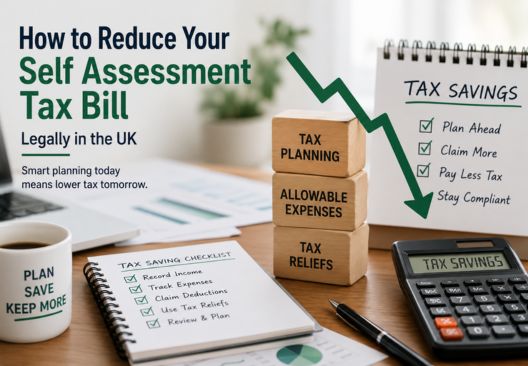
How to Reduce Your Self Assessment Tax Bill Legally in the UK
Paying tax is part of running a business or earning income in the UK, but paying more tax than you legally owe doesn't have to be.
Every year, thousands of sole traders, freelancers, landlords, contractors, and company directors submit their Self Assessment tax return in UK only to discover they have a much larger tax bill than expected. In many cases, it isn't because they earned significantly more income—it's because they missed legitimate tax reliefs, failed to claim allowable expenses, or didn't plan ahead before the tax year ended.
The good news is that reducing your Self Assessment tax bill doesn't require complicated tax avoidance schemes or risky financial arrangements.
HMRC provides several legitimate ways to reduce your tax liability, provided you understand the rules and keep accurate financial records. The key is knowing what you're entitled to claim and making informed decisions throughout the year instead of waiting until the filing deadline.
At TaxVATReturn, we regularly help UK taxpayers identify tax-saving opportunities while ensuring every Self Assessment tax return remains fully compliant with HMRC regulations. Whether you're self-employed, receive rental income, or run a limited company, careful tax planning can often reduce your overall tax bill legally.
In this guide, we'll explain practical and fully legal ways to reduce your Self Assessment tax bill in the UK, common mistakes to avoid, and why proactive tax planning often saves more money than people expect.
Can You Legally Reduce Your Self Assessment Tax Bill?
Yes.
Reducing your tax bill legally is not only allowed—it's encouraged, provided you follow HMRC rules correctly.
Many taxpayers mistakenly believe that claiming tax relief or allowable expenses is somehow "avoiding tax." In reality, HMRC has created these reliefs specifically to ensure people pay tax only on their taxable profits rather than their total income.
For example, if you've incurred genuine business expenses while earning your income, those costs can usually be deducted before your tax is calculated.
Similarly, pension contributions, charitable donations, capital allowances, and certain tax reliefs may all reduce the amount of tax you owe depending on your circumstances.
The important distinction is between tax planning, which is entirely legal, and tax evasion, which is not.
Good tax planning simply means organising your finances efficiently and claiming every relief that HMRC allows.
Understand How Your Self Assessment Tax Bill Is Calculated
Before looking at ways to reduce your tax bill, it's helpful to understand where the calculation comes from.
Your Self Assessment tax return doesn't calculate tax based solely on how much money entered your bank account.
Instead, HMRC generally calculates tax using your taxable income after allowable deductions and reliefs have been applied.
For someone who is self-employed, this usually means:
-
Total business income
-
Less allowable business expenses
-
Equals taxable profit
Your Income Tax and National Insurance contributions are then calculated based on those taxable profits.
The lower your legitimate taxable profit, the lower your overall tax bill is likely to be.
This is why accurate bookkeeping and understanding deductible expenses are so important.
Many taxpayers unknowingly increase their own tax bill simply because they fail to record business costs throughout the year.
Claim Every Allowable Business Expense
One of the simplest and most effective ways to reduce your Self Assessment tax bill legally is by claiming every allowable business expense you're entitled to.
Unfortunately, this is also where many taxpayers lose money.
HMRC allows businesses to deduct expenses that are incurred wholly and exclusively for business purposes. These expenses reduce your taxable profit before your tax is calculated.
Depending on your profession, allowable expenses may include office costs, business travel, professional subscriptions, marketing expenses, software, insurance, telephone bills, internet costs, equipment, stationery, and many other legitimate business purchases.
The problem isn't usually that taxpayers intentionally ignore these expenses.
More often, they simply forget to keep receipts, don't realise certain costs qualify, or fail to maintain proper financial records throughout the year.
Over several months, these overlooked expenses can add up to hundreds—or even thousands—of pounds in unnecessary tax.
Keep Accurate Financial Records Throughout the Year
One of the biggest mistakes people make is waiting until January to organise an entire year's worth of invoices, bank statements, and receipts.
By then, important documents may already be missing.
Good bookkeeping isn't just about staying organised. It's one of the most effective tax-saving habits you can develop.
When your financial records are updated regularly, it's much easier to identify deductible expenses, monitor business performance, and prepare an accurate Self Assessment tax return online.
Accurate records also reduce the likelihood of errors if HMRC ever requests additional information.
Many businesses discover extra deductible expenses simply because their bookkeeping is properly maintained throughout the year rather than rushed at the filing deadline.
Don't Ignore Pension Contributions
Making pension contributions isn't only about planning for retirement.
Depending on your circumstances, pension contributions can also reduce the amount of Income Tax you pay.
Many self-employed individuals overlook this opportunity because they're focused on immediate cash flow rather than long-term tax planning.
While pension rules vary depending on your income and contribution limits, contributing to a pension can provide valuable tax relief while helping you build financial security for the future.
Rather than viewing pension contributions purely as an expense, many taxpayers see them as a way of investing in retirement while reducing their current tax liability.
Professional advice is particularly valuable here because pension planning should always take your wider financial situation into account.
Make Use of Available Tax Reliefs
HMRC offers a range of legitimate tax reliefs, but many taxpayers only become aware of them after they've already submitted their return.
Depending on your circumstances, you may qualify for reliefs relating to charitable donations, business assets, capital allowances, or other eligible costs.
The availability of these reliefs depends on factors such as your income sources, business structure, and the nature of your expenses.
This is why relying solely on memory when completing your Self Assessment tax return online can sometimes be expensive.
Reviewing your financial activities carefully before filing often reveals opportunities that would otherwise have been missed.
Professional Self Assessment services in the UK can help ensure these reliefs are considered before your tax return is submitted.
Separate Personal and Business Finances
Mixing personal spending with business transactions creates unnecessary confusion when it's time to prepare your tax return.
Using a dedicated business bank account makes it much easier to identify business income, track expenses, and maintain accurate records throughout the year.
It also reduces the risk of accidentally claiming personal purchases as business expenses or overlooking legitimate business costs hidden within personal transactions.
Clear financial separation not only improves bookkeeping but also simplifies communication with your accountant and helps produce a more accurate HMRC Self Assessment.
For many small business owners, this simple habit saves significant time during tax season while reducing the chance of costly mistakes.
Why Early Tax Planning Usually Saves More Than Last-Minute Filing
Many taxpayers only start thinking about their tax bill a few weeks before the Self Assessment deadline.
By then, most tax-saving opportunities for that financial year have already passed.
Effective tax planning happens throughout the year—not just when you're completing your return.
Regularly reviewing your income, expenses, pension contributions, and business investments allows you to make informed decisions before the tax year ends.
This proactive approach often results in lower tax bills, improved cash flow, and fewer unexpected liabilities.
It's one of the main reasons many business owners choose to work with a Self Assessment accountant in the UK rather than treating tax as a once-a-year administrative task.
A little planning today can make a significant difference when your next Self Assessment tax bill arrives.
Common Mistakes That Can Increase Your Self Assessment Tax Bill
Reducing tax legally is not only about finding deductions. It is also about avoiding mistakes that unnecessarily increase your taxable profit or prevent you from claiming reliefs correctly.
One of the most common problems is incomplete record-keeping. When receipts, invoices, mileage records, or business subscriptions are missing, taxpayers often leave legitimate expenses out of their return. HMRC allows self-employed taxpayers to claim qualifying costs such as office expenses, business travel, insurance, professional fees, marketing, premises costs, and certain staff expenses. However, the costs must meet the relevant rules and be supported by reliable records.
Another costly mistake is confusing personal spending with business expenditure. A purchase does not automatically become tax-deductible simply because it was paid from a business account. Where an expense has both personal and business use, only the qualifying business portion can generally be claimed.
Some taxpayers also assume that every expensive business purchase can be entered as an ordinary expense. Equipment, machinery, business vehicles, and other assets may instead need to be treated under the capital allowances rules. Capital allowances can allow a business to deduct some or all of the qualifying asset’s value from profits before tax, but the treatment depends on the type of asset and the accounting method being used.
Submitting your return without reviewing the tax calculation is another avoidable error. Before filing, check whether all income sources have been included, whether expenses have been entered in the right categories, and whether relevant tax reliefs have been claimed.
Review Whether Simplified Expenses or Actual Costs Work Better
Self-employed taxpayers may be able to use simplified expenses for certain business costs rather than calculating the precise business proportion of every bill.
Simplified expenses use flat rates for areas such as working from home and certain vehicle costs. They can make record-keeping easier, but they do not always produce the largest deduction.
For example, someone who works from home regularly may be able to use a flat-rate calculation. Alternatively, actual costs may sometimes provide a more appropriate result, depending on the size of the home, business usage, utility costs, and working pattern.
HMRC explains that simplified expenses are optional. Taxpayers can decide whether the flat-rate method is suitable for their business rather than using it automatically.
The important point is to compare the available methods before submitting your return. Choosing the simplest method is not always the same as choosing the most tax-efficient one.
Accurate calculations become much easier when your records are maintained throughout the year. Our [Bookkeeping Services] can help you keep business income and expenses organised before the filing deadline.
Consider Capital Allowances Before Buying Business Equipment
If your business needs computers, tools, machinery, office equipment, or qualifying vehicles, the timing and tax treatment of the purchase may affect your Self Assessment bill.
Capital allowances are designed to provide tax relief when businesses purchase qualifying assets. In many cases, the Annual Investment Allowance may permit the full qualifying value of plant and machinery to be deducted from profits, subject to the applicable rules.
However, buying something purely to reduce tax is rarely a sensible business decision.
A £1,000 purchase does not usually save £1,000 in tax. It reduces the profit on which tax is calculated. You should therefore consider whether the equipment genuinely supports your business and whether your cash flow can comfortably absorb the cost.
Tax planning should improve your financial position, not encourage unnecessary spending.
Because the rules differ for business cars, cash-basis taxpayers, equipment, and other assets, professional advice may be valuable before making a significant purchase.
Claim the Correct Tax Relief on Pension Contributions
Private pension contributions can be an effective part of long-term financial and tax planning.
Basic-rate tax relief is often added through the pension provider under relief-at-source arrangements. Taxpayers paying Income Tax above the basic rate may be able to claim further relief through their Self Assessment return, depending on where they live in the UK and the tax rate that applies to their income.
This additional relief is sometimes missed because taxpayers assume the pension provider has already applied everything automatically.
Pension contributions are subject to earnings and annual allowance rules. The standard limits and available relief can also depend on individual circumstances, including income level, previous pension usage, and whether other pension restrictions apply.
Pensions should not be treated as a last-minute tax-saving shortcut. They are long-term financial products, and decisions should reflect retirement goals, affordability, and wider financial planning.
Check Whether Charitable Donations Affect Your Return
Donations made through Gift Aid can sometimes affect the tax position of higher-rate or additional-rate taxpayers.
Under Gift Aid, a charity can reclaim basic-rate tax on an eligible donation. Taxpayers paying tax above the basic rate may be able to claim the difference through Self Assessment.
You must keep accurate details of eligible donations and ensure you paid enough UK Income Tax or Capital Gains Tax to cover the amount reclaimed by the charities.
Charitable giving should always be driven by the desire to support a cause rather than solely by tax savings. However, where qualifying donations have already been made, failing to report them correctly could mean missing available relief.
Plan for Payments on Account
Sometimes a high Self Assessment bill is not entirely related to the tax due for the year just completed.
It may also include Payments on Account, which are advance payments towards the following year’s tax liability.
This often surprises first-time Self Assessment taxpayers because the January payment may include both the balancing tax due for the previous year and the first advance payment for the current year.
If your income is genuinely expected to fall, it may be possible to apply to reduce your Payments on Account. However, you should not reduce them without a reasonable basis. If the final liability is higher than the reduced amount, HMRC may charge interest on the shortfall.
Tax Planning for Sole Traders and Freelancers
For sole traders and freelancers, the most effective tax planning usually begins with reliable bookkeeping.
Regularly recording income and expenditure helps ensure that legitimate costs are not forgotten. It also allows you to estimate profits during the year rather than discovering your tax liability shortly before the deadline.
Sole traders should review costs such as:
-
Software and professional subscriptions
-
Business insurance
-
Marketing and website expenses
-
Business travel
-
Telephone and internet usage
-
Accountancy and legal fees
-
Training that supports existing business skills
-
Qualifying use of home costs
HMRC permits certain professional and accountancy fees incurred for business purposes as allowable expenses. It also provides guidance on when training costs may qualify as a business expense.
The objective is not to claim every purchase. It is to identify every legitimate business cost while excluding expenses that are private, unsupported, or disallowed.
Tax Planning for Landlords
Landlords face different rules from sole traders, particularly when dealing with property expenses, finance costs, repairs, replacements, and capital improvements.
A repair that restores a property to its previous condition may be treated differently from an improvement that increases the property’s value. Mortgage interest and other finance costs may also receive different treatment from ordinary property expenses.
Landlords should maintain clear records for each property, including rental income, letting-agent fees, insurance, maintenance invoices, safety checks, and other qualifying expenses.
If you receive rental income alongside employment or self-employment income, it is especially important to calculate your total tax position rather than viewing the property figures in isolation.
Tax Planning for Company Directors
Company directors may receive income through salary, dividends, benefits, rental income, or other sources.
Although a limited company and its director are legally separate, decisions made within the company can affect the director’s personal tax position.
Salary levels, dividend payments, pension contributions, benefits, director’s loan accounts, and business expenses should be considered together rather than independently.
Directors should avoid withdrawing money from the company without understanding how the payment will be recorded. A withdrawal might be treated as salary, a dividend, repayment of expenses, or a director’s loan, and each treatment can have different tax consequences.
Should You Hire an Accountant to Reduce Your Tax Bill?
You do not legally need an accountant simply because you file a Self Assessment return.
However, professional advice may be valuable when you have multiple income sources, rental property, capital gains, dividends, overseas income, complex business expenses, pension contributions, or uncertainty about HMRC rules.
A qualified accountant should not promise to make your tax bill disappear. Their role is to calculate the correct liability, identify legitimate reliefs, prevent avoidable errors, and help you plan ahead.
The fee paid to an accountant for business-related services may itself qualify as an allowable expense for a sole trader or business partnership where the cost is incurred for business purposes.
The greatest value often comes from receiving advice before the tax year ends. Once the year has closed, the available options may be more limited.
How TaxVATReturn Can Help You Reduce Tax Legally
At TaxVATReturn, we help sole traders, freelancers, landlords, contractors, directors, and other UK taxpayers prepare accurate Self Assessment tax returns while considering the reliefs and deductions relevant to their circumstances.
Our approach is not based on aggressive tax avoidance or unrealistic promises.
We review your income, expenses, pension information, property records, and other relevant financial details to help ensure that your tax return reflects the correct position.
Where appropriate, we can also help you improve bookkeeping, understand Payments on Account, organise business records, and plan for future liabilities.
Related services include:
-
[Property Accounting Services]
-
[CIS Return Services]
Final Thoughts: Pay the Right Amount, Not More Than You Owe
There is nothing wrong with wanting to reduce your Self Assessment tax bill.
The important point is to do it legally, accurately, and with proper supporting records.
Claiming allowable expenses, reviewing pension tax relief, considering capital allowances, keeping organised accounts, and planning before the tax year ends can all help ensure you pay the correct amount.
The goal should never be to hide income or create artificial expenses. It should be to understand the tax rules and make use of the legitimate deductions and reliefs available to you.
Tax rules can be complex, and the right approach depends on your individual circumstances. Before making significant pension, investment, asset-purchase, or business-structure decisions, consider obtaining professional advice.
Need help reducing your Self Assessment tax bill legally?
Contact TaxVATReturn for professional Self Assessment and tax-planning support. We can help you prepare an accurate return, identify eligible deductions, understand your tax calculation, and remain compliant with HMRC.
This article provides general information and does not constitute personalised tax or financial advice. Tax treatment depends on individual circumstances and may change.
Recent Article