
Mandatory Payrolling of Benefits in Kind 2027
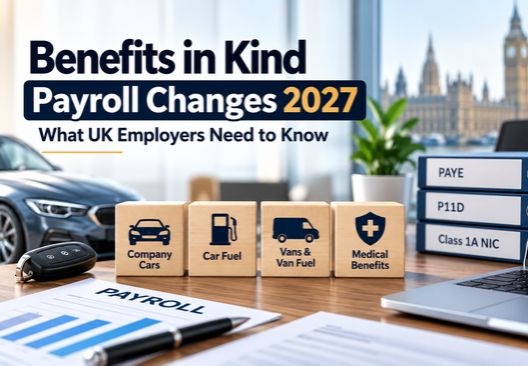
From 6 April 2027, UK employers will have to report and payroll certain benefits in kind in real time through payroll software. The first phase covers company cars, car fuel, vans, van fuel and employer-provided medical benefits. Income Tax and associated Class 1A National Insurance will increasingly be dealt with through payroll rather than relying on the traditional year-end reporting process
For employers, this is much more than a small payroll software update.
Businesses that currently identify benefits at the end of the tax year will need processes capable of capturing relevant information much earlier. Payroll teams, HR departments, accountants and benefit administrators will need to work together so that taxable benefits are calculated correctly and reported through Real Time Information.
With April 2027 approaching, employers should be using the remaining preparation period to understand which benefits are affected, review their payroll software and establish who will be responsible for supplying benefit information before each payroll run.
What Is Mandatory Payrolling of Benefits in Kind?
A benefit in kind, often abbreviated to BiK, is a non-cash benefit provided by an employer that may create a tax liability for the employee.
Examples can include company cars, private medical insurance, accommodation and beneficial loans.
Under the traditional system, many taxable benefits are dealt with through year-end reporting. Employers may report benefits using forms such as P11D, while the employee's tax can subsequently be collected through their tax code.
Mandatory payrolling changes that process benefits brought within the new regime.
Instead of waiting until after the tax year, the taxable value of affected benefits will be incorporated into payroll reporting during the year. Relevant information will be reported through the Full Payment Submission (FPS) used within Real Time Information.
For employers already outsourcing their payroll, this makes it important to check whether their existing payroll services will be able to capture and report benefits correctly from April 2027.
Which Benefits in Kind Will Be Mandatory From April 2027?
The government is introducing mandatory payrolling in phases rather than moving every benefit into payroll at the same time.
The position currently planned is:
| Period | Benefits affected |
|---|---|
| From 6 April 2027 | Company cars, car fuel, vans, van fuel and employer-provided medical benefits |
| From 6 April 2028 | Most remaining benefits in kind |
| Loans and accommodation | Mandatory implementation date to be confirmed; voluntary payrolling will be available |
This phased approach is important because employers should not assume that the P11D system disappears completely on 6 April 2027. GOV.UK
Employment-related loans and living accommodation remain outside the initial mandatory phases under the current plans. Employers will be able to choose voluntary payrolling for non-mandatory benefits, subject to the applicable registration requirements.
That means many businesses could temporarily operate a mixed system: some benefits reported through payroll and others still dealt with through year-end arrangements.
Will P11D Forms Be Abolished in 2027?
No — not completely.
This is an important distinction because headlines about mandatory payrolling can make it sound as though P11Ds disappear for every employer and every benefit from April 2027.
For benefits included in the first mandatory phase, employers will generally move towards real-time reporting through payroll rather than relying on P11D reporting for those benefits.
However, P11D and P11D(b) reporting can still remain relevant in circumstances where benefits are not mandatorily payrolled. Current HMRC plans also retain year-end reporting arrangements for certain cases, including employment-related loans and accommodation where they are not voluntarily payrolled.
Employers therefore need to identify which benefits they provide, rather than simply assuming that their entire P11D process can be removed.
How Will Benefits in Kind Be Reported Through Payroll?
The change brings benefits into the same Real Time Information environment employers already use for salary and other payroll information.
For benefits included in the first phase, the relevant taxable value will need to be reflected through the employee's payroll during the tax year and reported through the Full Payment Submission.
That means benefit information needs to reach the payroll function in time for processing.
This could create a major operational change for businesses where payroll and HR currently work independently.
For example, if an employee receives a new company car, changes vehicle, starts private medical cover or stops receiving a benefit, the payroll team may need that information far sooner than under an annual P11D process.
Employers using PAYE registration and payroll support should therefore ensure their payroll setup is capable of handling these additional reporting responsibilities.
What Happens to Class 1A National Insurance?
One of the most significant aspects of the change is the treatment of Class 1A National Insurance contributions.
Under the new system, the FPS will be used to report information allowing Income Tax and Class 1A National Insurance on mandatory benefits to be dealt with in real time. HMRC's current guidance includes specific RTI data requirements for reporting Class 1A NIC associated with payrolled benefits.
For employers, this means benefits administration becomes much more closely connected with monthly or weekly payroll processes.
The financial impact also deserves attention.
Moving liabilities into real-time payroll can affect the timing of employer cash outflows. Businesses should therefore consider these changes not only as a compliance issue but as part of payroll and cash-flow planning.
Where payroll information feeds into wider accounts, keeping business bookkeeping records up to date becomes increasingly important.
Do Employers Need to Register for Mandatory Payrolling?
Employers will not need to register simply to payroll the benefits that become mandatory from April 2027.
Those mandatory requirements will apply through the new reporting system.
Registration becomes relevant where an employer wishes to voluntarily payroll benefits that are not yet mandatory.
HMRC's current timetable says the voluntary registration service for the 2027/28 tax year is due to open in November 2026, with registration required by 5 April 2027 for employers wanting to voluntarily payroll relevant non-mandatory benefits.
This creates an important planning decision.
Some employers may prefer to move additional benefits into payroll voluntarily so that they operate a more consistent system. Others may decide that retaining year-end reporting for non-mandatory benefits temporarily is operationally simpler.
The right approach depends on the benefits provided, payroll systems, number of employees and internal reporting processes.
[EXPERT TIP: Do not wait until March 2027 to identify your benefits. Create a complete benefits register now showing the benefit type, employees receiving it, taxable value, current reporting method and the person responsible for supplying the information to payroll.]
Why Could the 2027 Payroll Changes Cause Problems for Employers?
The biggest risk is not necessarily calculating payroll tax incorrectly.
It is information arriving too late.
Under an annual process, a business may have had several months after the tax year ended to identify and reconcile benefit information.
Real-time reporting shortens that window considerably.
Consider private medical insurance. The payroll team may depend on HR or the insurer for changes to employee membership.
For company cars, someone may need to record vehicle details, availability dates, changes to vehicles and fuel benefits.
If HR updates its records but payroll is not informed until weeks later, corrections may be required.
This is why the move to mandatory payrolling of benefits in kind should be treated as a business process project, not simply a payroll calculation change.
For limited companies, the payroll process should also connect properly with the company's broader financial reporting and limited company accounting.
What Should Employers Do Before April 2027?
The preparation period should focus on three things: data, software and responsibility.
First, establish exactly which taxable benefits your business provides. Compare that information with existing payroll and P11D records and identify which benefits enter mandatory payrolling in April 2027.
Second, speak with your payroll software provider or payroll accountant. The software needs to support the additional RTI information required for benefits in kind.
Third, establish a reliable flow of information between HR, management and payroll. Someone should have clear responsibility for notifying payroll when an employee starts, stops or changes a taxable benefit.
Employers should also review how benefit costs and employer National Insurance are reflected within their accounting records.
For newly established businesses that expect to provide employee benefits, getting the structure right from the beginning may be easier than changing processes later. TaxVATReturn can support new employers with company formation and accounting setup alongside PAYE and payroll requirements.
[EXPERT TIP: Run a test before April 2027. Take one normal payroll period and check whether your payroll team could obtain every company car, fuel, van and medical-benefit change before the payroll cut-off. Any information gap you find now is easier to fix than after mandatory reporting begins.]
Will Employees Notice the Change?
Potentially, yes.
One of the objectives of real-time payrolling is for tax on benefits to be dealt with more closely alongside the period in which employees receive them.
Employees who are accustomed to benefit-related adjustments appearing through their tax codes may therefore see changes in how benefit tax is reflected in payroll and take-home pay.
Communication will matter.
Employers should explain that a change in payslip taxation does not necessarily mean the employee has suddenly received an additional benefit or that the benefit itself has become more expensive. In many cases, it reflects a change in when and how the tax is collected.
Clear communication before April 2027 could prevent unnecessary payroll queries.
What Happens if an Employer Makes a Mistake?
HMRC has announced a transitional approach for the first year.
For 2027/28, errors relating to mandatory payrolling in RTI returns are expected to benefit from an easement from inaccuracy penalties where there is no evidence of deliberate non-compliance.
That does not mean employers can ignore the rules.
Existing late filing and late payment penalties can still apply, and interest may arise where amounts are paid late. From later years, the normal penalty regime is expected to apply more fully to mandatory benefits reporting.
The sensible approach is therefore to use the first year as a transition period while still aiming for accurate and timely reporting from the beginning.
Can a Payroll Accountant Handle Benefits in Kind?
Yes. For many small and medium-sized employers, outsourcing the process may become increasingly attractive as payroll reporting becomes more complex.
A payroll accountant can help maintain payroll records, process employee pay, deal with PAYE and RTI reporting and incorporate applicable benefits into the payroll process.
The key is ensuring the payroll provider receives complete information from the employer.
Outsourcing payroll does not remove the need for the business to tell the provider when benefits are introduced, changed or withdrawn.
At TaxVATReturn, our UK payroll services can support employers with payroll processing and wider accounting requirements, helping businesses prepare for changes such as mandatory payrolling of benefits in kind.
Frequently Asked Questions About Payrolling Benefits in Kind
When does mandatory payrolling of benefits in kind start?
The first phase is planned to start on 6 April 2027. It covers company cars, car fuel, vans, van fuel and employer-provided medical benefits. Most other benefits are expected to move into mandatory payrolling from April 2028.
Which benefits must be payrolled from April 2027?
Phase 1 applies to company cars, car fuel, vans, van fuel and employer-provided medical benefits. Other benefits follow later under the phased implementation.
Will employers still need P11D forms after April 2027?
In some circumstances, yes. P11D reporting will remain relevant for benefits and situations that have not moved into mandatory real-time payrolling. Loans and accommodation are particularly important exceptions under the current timetable.
How will Class 1A National Insurance be reported?
For benefits included within mandatory payrolling, relevant Class 1A National Insurance information will be reported in real time through payroll and RTI rather than relying only on the traditional year-end process.
Prepare Your Payroll Before April 2027
The shift to mandatory payrolling of benefits in kind is a significant change to UK payroll administration.
For employers providing company cars, fuel, vans or private medical benefits, 6 April 2027 is the key date.
The businesses best prepared for the change will be those that already know which benefits they provide, have accurate employee records, use suitable payroll software and have a reliable process for moving information between HR, management and payroll.
Waiting until the first payroll run of the 2027/28 tax year could create unnecessary pressure.
If your business needs help reviewing its payroll processes or preparing for the new benefits reporting requirements, TaxVATReturn provides professional payroll services for UK businesses.
Call 01284 332375 or email info@taxvatreturn.co.uk to discuss your payroll requirements.
Recent Article