Self Assessment Payment Changes: What HMRC Proposes
For years, the Self Assessment payment cycle has followed a familiar pattern: taxpayers calculate what they owe, make a balancing payment in January and, where Payments on Account apply, make advance payments in January and July.
HMRC is now considering a major change to that system.
In June 2026, the government published a consultation on more timely payments in Income Tax Self Assessment (ITSA). The direction is clear: rather than allowing substantial amounts of tax to build up until January or relying on two large Payments on Account during the year, HMRC wants to move some taxpayers towards smaller, more frequent payments that are collected closer to when income is earned.
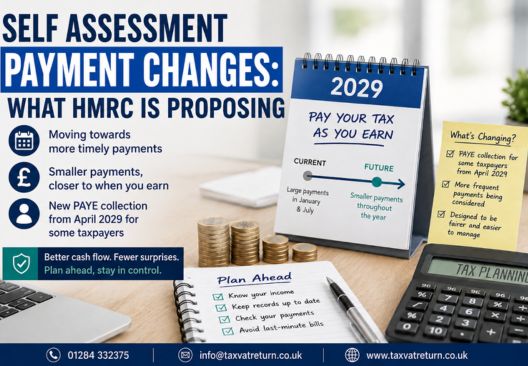
Part of that change has already been announced for April 2029. Self Assessment taxpayers who also have sufficient income taxed through PAYE are expected to begin paying forecast Self Assessment liabilities through their PAYE deductions during the year. For sole traders, landlords and others who do not have enough PAYE income, HMRC is also exploring whether the existing Payments on Account system should become more frequent. However, that wider reform has not yet been finalised.
That distinction matters. Headlines suggesting that everyone will soon be forced to pay Self Assessment monthly would be premature. But the consultation does indicate where the tax system could be heading, and anyone who regularly faces a large January tax bill should understand what is being considered.
What Are the Proposed Self Assessment Payment Changes?
The government's objective is to bring Self Assessment tax payments closer to the period in which the underlying income is earned.
Under the current system, tax can sometimes be paid a considerable time after the income that created the liability was received. HMRC says that in some circumstances the delay can be as long as 22 months. Around one in five Income Tax Self Assessment bills are currently paid late, and the government believes large, infrequent bills are one factor contributing to payment difficulties and tax debt.
The reform is therefore not primarily about increasing tax rates or creating a new tax. It is about changing when existing Self Assessment liabilities are paid.
For people who have both PAYE income and Self Assessment income, the government has already announced a significant change from April 2029. Where there is sufficient PAYE income, forecast Self Assessment liabilities would be collected through PAYE during each pay period rather than relying mainly on later lump-sum payments.
For taxpayers who cannot use PAYE in this way, including many full-time sole traders and landlords, HMRC has consulted on whether the current direct Payments on Account system could also be made more frequent.
If you are unfamiliar with the current system, our Self Assessment Payment on Account guide explains why HMRC currently asks many taxpayers to make advance payments in January and July and why the first large bill can come as such a surprise.
How Does Self Assessment Payment Work Right Now?
Before looking at what may change, it is important to understand what remains in force today.
Under the existing system, Payments on Account generally apply where your relevant Self Assessment liability exceeds £1,000 and less than 80% of the tax due has already been collected at source, such as through PAYE. Two Payments on Account are normally required: one by 31 January and another by 31 July. Each is generally based on half of the previous year's relevant liability. Any remaining amount is then settled through a balancing payment.
This structure can create a difficult first year for someone whose business has grown.
Imagine a sole trader who completes their return and discovers that £8,000 of tax is due. If Payments on Account also apply, the January amount could include the £8,000 balancing liability plus a £4,000 first Payment on Account towards the following year. The second £4,000 advance payment would then be due in July.
Nothing has necessarily gone wrong with the tax calculation, but a taxpayer who expected to pay £8,000 can suddenly need £12,000 in January.
That is the type of “bill shock” HMRC says more timely payments could help reduce.
Will Self Assessment Tax Be Taken From Your Salary?
For some taxpayers, that is the direction of the confirmed reform.
From April 2029, Self Assessment taxpayers with sufficient PAYE income are expected to make payments towards their forecast Self Assessment liability through PAYE each payday. HMRC estimates that of approximately seven million people who currently have both PAYE and Self Assessment income, around 2.1 million could have sufficient PAYE income to fall within the proposed system under current assumptions.
The forecast would initially be based on the taxpayer's most recently filed Self Assessment return. Taxpayers would then be able to update the forecast when their circumstances change.
For example, someone may work full time while also earning taxable income from consulting, freelancing, property or another business. Instead of waiting until January and July to pay much of the tax on that additional income, HMRC could adjust their PAYE deductions so part of the forecast liability is collected from salary or pension payments throughout the year.
This could make budgeting easier for some taxpayers, but it could also mean noticeably lower take-home pay.
HMRC currently limits certain PAYE deductions so that no more than 50% of PAYE income is taken in tax during a pay period. The consultation specifically considered what safeguards should apply when Self Assessment liabilities start being collected in this way.
Does This Mean Everyone Will Pay Self Assessment Monthly?
No.
This is one of the most important points to understand about the consultation.
The April 2029 PAYE change relates to Self Assessment taxpayers who have sufficient PAYE income. It does not automatically provide a payment mechanism for people whose income comes mainly or entirely from self-employment, property or other Self Assessment sources.
HMRC says there are around 9.5 million taxpayers who cannot pay Self Assessment liabilities through PAYE in this way, and around 2.5 million of them currently make twice-yearly Payments on Account. The government has therefore been consulting on whether more regular direct payments could also work for this group.
But no final decision has yet been made about how frequently those taxpayers would pay or exactly how the system would operate.
The consultation closed on 4 August 2026, and the government has said it expects to publish a response in Autumn 2026. Any legislation required for the April 2029 changes would need to be introduced through a Finance Bill.
So if you are a sole trader or landlord currently paying in January and July, do not change your payment arrangements based on these proposals. The existing rules continue to apply until HMRC formally changes them.
Will More Frequent Payments Mean Paying More Tax?
No, not simply because the timing changes.
HMRC explicitly states that the proposed reforms are intended to change when tax is paid, rather than increase the amount of tax ultimately due. Forecast payments would be made during the year and then reconciled against the taxpayer's actual Self Assessment liability once the tax return is completed.
If too little has been paid, a balancing payment could still be required.
If too much has been paid, HMRC could owe the taxpayer a repayment.
That makes accurate forecasting important. A sole trader whose profits fall significantly compared with the previous year should not want HMRC continuing to collect tax based on an outdated higher figure. Equally, someone whose income rises sharply may prefer to adjust their forecast rather than face another unexpected balancing payment later.
Good bookkeeping becomes increasingly valuable in that environment because you need a reliable view of your current income and expenses rather than waiting until the end of the tax year to discover what happened.
Our guide to bookkeeping for small businesses explains why keeping financial records up to date throughout the year can improve both tax planning and cash-flow visibility.
Could the New System Actually Help Sole Traders?
Potentially, yes—but not in every case.
One advantage of more frequent payments is predictability. A business owner who currently struggles to ring-fence enough money for January may find smaller payments throughout the year easier to manage.
HMRC says one of the aims is to reduce the risk of tax debt by avoiding large, infrequent liabilities. This could be particularly useful for people who are new to self-employment and experience their first significant Self Assessment bill without fully understanding Payments on Account.
However, there is another side to the argument.
Many businesses do not earn income evenly throughout the year. A wedding photographer, construction contractor, holiday-property landlord or seasonal retailer may have very strong months followed by periods of much lower income. For those taxpayers, fixed monthly payments based on historical figures could create cash-flow pressure at precisely the wrong time.
HMRC acknowledges this concern and has specifically considered how taxpayers with seasonal or irregular income could update forecasts and what safeguards or easements might be required.
This is why the final design matters far more than simply describing regular payment as good or bad.
The Transition to the New System Could Be the Difficult Part
One of the most important issues in the consultation is the transition period.
When the new system begins, some taxpayers may still be settling liabilities under the existing payment schedule while also beginning to make payments under the new one.
HMRC itself recognises that, during the transition, taxpayers could be paying liabilities relating to different tax years at the same time.
That could create confusion if taxpayers do not clearly understand which payment relates to which tax year.
For anyone approaching 2029, tax planning may therefore become particularly important. Filing returns late, maintaining incomplete records or failing to understand existing Payments on Account could make the transition substantially harder.
If you already find Self Assessment calculations confusing, our online Self Assessment filing guide explains the records, calculations and checks that should be completed before a return is submitted.
How Does Making Tax Digital Fit Into This?
This is where the wider direction of HMRC becomes easier to see.
Making Tax Digital for Income Tax has already moved many sole traders and landlords towards keeping digital records and sending information to HMRC more regularly. The timely-payment proposals now explore whether the payment of tax should also move closer to real time.
The two systems should not be confused.
MTD quarterly updates do not currently mean that Income Tax has to be paid quarterly simply because information is being reported quarterly.
Our Making Tax Digital guide for UK businesses explains the current MTD reporting rules and phased income thresholds.
However, when MTD reporting and more timely tax payments are viewed together, the long-term policy direction is clear: HMRC wants the tax system to rely less on taxpayers reconstructing an entire year's finances long after the income was earned.
For accountants and business owners, that makes real-time bookkeeping, forecasting and tax planning increasingly important.
Can You Already Pay Self Assessment Monthly?
Yes—and this is another area where the proposed reforms can cause confusion.
You do not currently have to wait until January to put money towards your tax bill.
HMRC already allows eligible taxpayers to make voluntary weekly or monthly payments using a Budget Payment Plan. The government has also been developing this service further through the HMRC app. These payments count towards a future Self Assessment liability.
The difference is that today's Budget Payment Plan is generally voluntary.
The 2029 reforms would make more timely payment part of the formal payment system for certain taxpayers rather than simply an optional budgeting tool.
For business owners who consistently struggle with large January bills, voluntarily setting money aside throughout the year can already be a sensible habit—even before the legislation changes.
What Should Self Assessment Taxpayers Do Now?
For now, continue following the existing payment rules.
If Payments on Account apply to you, January and July remain the key payment dates. Do not stop making them because you have read that the system may change in 2029.
What you can do now is improve the financial process behind those payments.
Know what your current Payments on Account represent. Monitor profit during the year rather than waiting until your return is prepared. Keep bookkeeping current. If income falls significantly, check whether reducing your Payments on Account is appropriate rather than automatically paying an amount based on a much stronger previous year.
And most importantly, do not treat Self Assessment as a January-only responsibility.
After you submit your return, you can use our guide on checking whether HMRC has processed your tax return to understand what happens next and where to check your payment position.
What Does This Mean for the Future of Self Assessment?
The direction is increasingly difficult to ignore.
HMRC is moving towards a tax system where information is reported sooner, records are maintained digitally and tax payments are made closer to the point at which income arises.
For some taxpayers, that could mean fewer stressful January bills and easier budgeting. For others—particularly people with irregular income—the loss of flexibility could create new cash-flow challenges.
The important point is that not every proposal discussed in the 2026 consultation is final. The confirmed April 2029 direction applies specifically to taxpayers with sufficient PAYE income, while wider reform of direct Payments on Account is still being considered.
At TaxVATReturn, we help sole traders, landlords, freelancers and individuals with Self Assessment, Payments on Account, bookkeeping and tax planning. If you are regularly surprised by your January tax bill, unsure whether your Payments on Account are correct or want to prepare for the changing Self Assessment system, getting your records and forecasts under control now will put you in a much stronger position.
Need help understanding your Self Assessment payments?
Contact TaxVATReturn on 01284 332375 or email info@taxvatreturn.co.uk for professional support with Self Assessment, Payments on Account, bookkeeping and tax planning.
This article is for general information and reflects HMRC and government proposals available in August 2026. Some measures discussed are subject to consultation and may change before implementation. Individual tax circumstances differ, so professional advice should be obtained where appropriate.
Recent Article