Self Assessment Payment on Account UK
If you've recently completed your Self Assessment tax return in the UK and found that HMRC is asking you to pay far more than you expected, you're certainly not the first person to experience it. One of the most common conversations we have with new clients starts with the same question:
"I've already paid my tax. Why is HMRC asking me for another payment?"
It's a frustrating situation, particularly if you've carefully budgeted for your tax bill only to discover that the amount due is almost double what you expected. At first glance, it can feel like you've been charged twice. In reality, that's rarely what's happened.
The extra amount is usually linked to Self Assessment Payment on Account, a rule that catches thousands of sole traders, freelancers, landlords and business owners by surprise every year. The problem isn't that the system is hidden—it's that most people don't come across it until they file their first significant Self Assessment tax return.
At TaxVATReturn, we regularly help clients across the UK understand why these payments appear, whether the calculation is correct and, where appropriate, whether the amount can be reduced. If you're looking for reliable Self Assessment services in the UK, understanding how Payment on Account works is one of the best ways to avoid unnecessary stress and improve your cash flow planning.
What Is Self Assessment Payment on Account in the UK?
A Self Assessment Payment on Account is an advance payment towards your next year's Income Tax and Class 4 National Insurance. Instead of waiting until the following tax year has finished, HMRC asks eligible taxpayers to pay part of their estimated tax bill in advance.
Many people misunderstand this and assume they're paying extra tax. You're not. You're simply paying part of next year's expected liability before it falls due.
For example, if your business has had a profitable year and your tax liability increases, HMRC assumes that your income may remain at a similar level. Rather than waiting another twelve months, it collects part of the estimated tax early.
While that approach helps HMRC spread tax collection throughout the year, it can leave taxpayers wondering why their HMRC Self Assessment calculation looks so much higher than expected.
This is one of the reasons why many individuals choose professional Self Assessment tax return services in the UK rather than relying solely on online calculators or trying to interpret HMRC's figures themselves.
Why Does Payment on Account Confuse So Many Taxpayers?
Imagine you're a self-employed electrician. You've spent the year setting money aside for your tax bill and expect to owe around £5,000.
You submit your return, log into your HMRC account and suddenly the amount due is almost £10,000.
Your immediate reaction is understandable. Most people assume something has gone wrong.
The reality is usually much simpler. HMRC has calculated your tax for the year you've just completed and then added the first advance payment for the following tax year.
Nothing has been charged twice. The calculation simply includes two separate obligations within the same statement.
Unfortunately, this explanation often comes after the shock of seeing a much larger bill. That's why taxpayers frequently contact a Self Assessment accountant in the UK after filing rather than before.
A little planning beforehand can make a significant difference, especially if you're running a growing business or your income changes from year to year.
Who Has to Pay Self Assessment Payment on Account?
Not everyone who files a tax return will receive a Payment on Account request. HMRC generally applies the rules when your Self Assessment tax bill is more than £1,000 and less than 80% of your tax has already been collected through PAYE.
This commonly affects people who earn income that isn't automatically taxed before they receive it. Sole traders, consultants, landlords, freelancers, contractors and individuals with multiple income streams are among those most likely to be affected.
If you're filing a Self Assessment tax return in the UK for the first time after a successful year in business, there's a good chance that Payment on Account could form part of your calculation.
Understanding this before you submit your return makes budgeting much easier. Instead of treating the extra amount as an unexpected cost, you can prepare for it in advance and avoid unnecessary financial pressure.
For many business owners, this is where working with an experienced Self Assessment accountant UK becomes valuable. Rather than simply submitting figures to HMRC, a professional accountant can explain how your tax bill has been calculated and whether there are opportunities to improve your tax planning.
How Does HMRC Calculate Payment on Account?
The calculation itself is relatively straightforward, although it often appears confusing when you first see it.
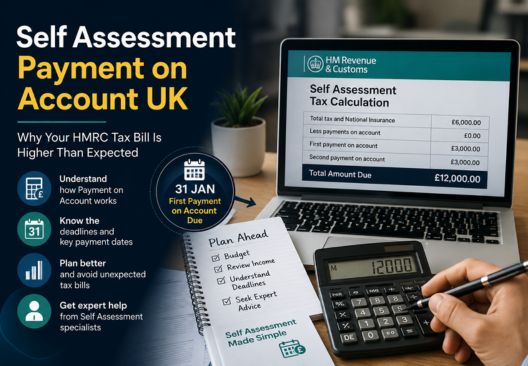
HMRC looks at your previous year's Income Tax and Class 4 National Insurance liability. It then divides that amount into two advance payments for the following tax year.
Suppose your total qualifying tax liability is £8,000.
You'll pay the £8,000 that relates to the tax year you've just completed. Alongside that, HMRC may ask for a first Payment on Account of £4,000 due on 31 January and a second Payment on Account of another £4,000 due on 31 July.
This means your first payment after submitting your return could total £12,000.
It's easy to see why many people believe they've been overcharged.
The important point to remember is that those advance payments aren't additional tax. They're credited against your next Self Assessment tax return. If your income remains broadly the same, you'll already have paid a significant proportion of next year's bill.
Payment on Account Deadlines You Should Never Ignore
The deadlines are just as important as understanding the calculation itself.
The first Payment on Account is due on 31 January, at the same time as your balancing payment for the previous tax year.
The second Payment on Account is due on 31 July.
Missing either deadline can result in interest charges from HMRC, even if you intend to pay later. That's why many people using online Self Assessment services in the UK choose to prepare their tax return well before January rather than leaving everything until the last minute.
Planning ahead also gives you time to review your figures, understand whether Payment on Account applies and decide whether any adjustments are needed based on your expected income.
Can You Reduce Your Payment on Account?
One of the biggest misconceptions is that once HMRC issues a Payment on Account, there's nothing you can do about it.
That's not always true.
If you genuinely expect your taxable income to be lower than the previous year, you may be able to apply to reduce your Payments on Account. This often happens when a business experiences a quieter year, a landlord sells a property, a freelancer loses a major client or someone decides to reduce their working hours.
However, reducing your payments shouldn't be based on guesswork. If your estimate is too low and your actual tax bill turns out to be higher, HMRC may charge interest on the shortfall.
This is why it's worth reviewing your figures with a professional offering Self Assessment services in the UK before requesting any reduction. A realistic estimate can help protect your cash flow while ensuring you remain fully compliant with HMRC requirements.
Visit: https://taxvatreturn.co.uk
Email: info@taxvatreturn.co.uk
Call: 01284 332375
Recent Article