
VAT for Freelancers UK: What You Need to Know
VAT for Freelancers UK: What You Need to Know
Freelancing often starts simply. You invoice a few clients, record your expenses and deal with Self Assessment once a year.
VAT can change that surprisingly quickly.
A freelancer can cross the registration threshold during a strong year, start working with overseas clients, purchase services from foreign suppliers or discover that the VAT treatment of different projects is not as straightforward as expected.
Direct answer: Freelancers in the UK generally need to register for VAT when their taxable turnover exceeds £90,000 over a rolling 12-month period or when they expect taxable turnover to exceed £90,000 within the next 30 days. Registration can also be voluntary below the threshold. Once registered, freelancers normally need digital VAT records and compatible software for their VAT Returns.
The important point is that VAT is based on taxable turnover, not profit.
A freelancer earning £100,000 in fees but spending £55,000 running the business cannot simply say the business only made £45,000 and therefore remains below the VAT threshold.
That distinction catches growing freelancers surprisingly often.
When Does a Freelancer Have to Register for VAT?
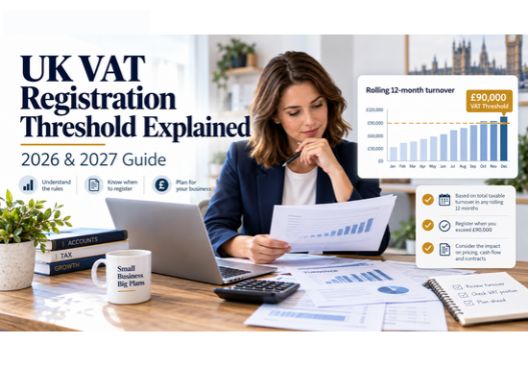
For the 2026/27 tax year, the UK VAT registration threshold remains £90,000. The test looks at taxable turnover over a rolling 12-month period rather than simply your accounting year or the tax year.
That means checking turnover only once every April is not enough.
Consider a freelance consultant whose taxable sales grow like this:
| Position | Amount |
|---|---|
| Previous 12 months' taxable fees | £84,000 |
| New project invoiced this month | £9,000 |
| Rolling taxable turnover | £93,000 |
The freelancer has crossed £90,000 even though the business may still think of itself as relatively small.
This is why good bookkeeping becomes important well before registration. If you cannot quickly determine your rolling 12-month taxable turnover, it becomes much easier to register late.
For a broader explanation of the registration rules, see our VAT Registration UK 2026 guide.
Is Every Freelancer's Income Included in the VAT Threshold?
Not necessarily.
The test is based on VAT-taxable turnover, so the VAT treatment of what you supply matters. Standard-rated, reduced-rated and zero-rated taxable supplies can contribute towards the threshold, while exempt or genuinely outside-the-scope supplies are treated differently. GOV.UK
This becomes particularly important for freelancers with several types of income.
A consultant might have ordinary UK consultancy fees, training income, overseas work and additional business activities. Simply adding every payment entering the bank account is not always the correct way to determine the VAT position.
[EXPERT TIP: Monitor VAT taxable turnover separately from accounting profit. A monthly rolling-turnover report can warn you before you cross the registration threshold.]
What If Your Clients Are Outside the UK?
This is where freelancer VAT often moves beyond a simple registration question.
The VAT treatment of services can depend on the place of supply.
HMRC's guidance explains that if the place of supply is in the UK, UK VAT may apply. If the place of supply is outside the UK, the supply can fall outside UK VAT, although tax obligations may arise elsewhere. Evidence supporting the customer's location and status can therefore matter.
For example, imagine a UK marketing consultant working with:
- UK limited companies
- US corporate clients
- EU businesses
- individual overseas consumers
Those invoices should not automatically be treated identically just because the freelancer provided the same marketing service.
The customer's location, whether the customer is a business and the precise service supplied can affect the VAT treatment.
That is one reason specialist VAT services for freelancers can become valuable even before turnover becomes very large.
What About Software Bought From Overseas?
Modern freelancers regularly pay overseas companies for:
- Adobe
- hosting
- cloud software
- marketing platforms
- project-management systems
- AI tools
- subscription services
Buying services from overseas can create another VAT consideration.
HMRC's reverse-charge rules can require a UK business receiving certain services from an overseas supplier to account for VAT through its VAT Return.
A freelancer who only looks at sales invoices may therefore miss VAT consequences arising from the purchase side of the business.
This is especially relevant for digital businesses where several monthly software subscriptions are purchased from companies outside the UK.
Do Freelancers Have to Use Making Tax Digital for VAT?
VAT-registered businesses generally need to keep specified VAT records digitally and submit VAT Returns using compatible software under Making Tax Digital for VAT, unless an exemption applies.
The required digital records include information about supplies made and received, VAT rates, adjustments and certain reverse-charge transactions.
This means VAT compliance is increasingly connected to the quality of your bookkeeping.
Waiting until the VAT deadline and then attempting to reconstruct three months of transactions from bank statements is not a reliable system.
If your records are becoming difficult to manage, our bookkeeping services for small businesses guide explains why regular bookkeeping provides much better visibility than year-end clean-up.
Should a Freelancer Register for VAT Voluntarily?
You can choose to register even if your taxable turnover is below £90,000.
Whether that is commercially sensible depends on the business.
A freelancer mainly selling services to VAT-registered businesses may view VAT differently from someone selling directly to consumers who cannot reclaim it.
The costs of the business matter too.
If you have significant eligible VAT-bearing business expenditure, voluntary registration may allow input VAT recovery, subject to the normal rules.
But voluntary registration also introduces VAT Returns, digital records and additional compliance.
So the question should not simply be:
“Can I register voluntarily?”
It should be:
“What would registration do to my pricing, clients, cash flow and administration?”
That is a much better business decision.
Could Cash Accounting Help, Freelancers?
Potentially.
Under the VAT Cash Accounting Scheme, an eligible business generally accounts for VAT on sales when customers actually pay rather than simply when invoices are raised. VAT on purchases is also normally reclaimed when suppliers have been paid.
Businesses can generally enter the scheme where estimated VAT-taxable turnover is £1.35 million or less, subject to eligibility rules.
For freelancers dealing with slow-paying clients, that timing difference can matter.
Imagine issuing a £12,000 invoice and then waiting 90 days for payment. Under different VAT accounting methods, the timing of when VAT becomes payable can affect cash flow.
That does not automatically make cash accounting the right choice, but it is an example of why VAT planning involves more than completing nine boxes every quarter.
When Should a Freelancer Consider Professional VAT Support?
The point where professional help becomes valuable is not identical for every freelancer.
It tends to become more useful when turnover approaches the threshold, several income streams exist, overseas clients or suppliers are involved, bookkeeping is no longer clean or historic VAT treatment is uncertain.
Another warning sign is when preparing the VAT Return becomes an investigation every quarter.
If you regularly have to ask:
“Where did this payment come from?”
“Do I have the invoice?”
“Should VAT have been charged?”
“Why doesn't the bookkeeping match the bank?”
then the VAT Return is exposing a bookkeeping problem rather than creating one.
TaxVATReturn provides accounting support specifically for self-employed professionals through our freelancer accounting services.
[EXPERT TIP: Do not wait until you are already above the VAT threshold to review your position. The best time to plan pricing, software and record-keeping is while registration is still approaching.]
VAT for Freelancers: The Practical Takeaway
VAT does not suddenly become complicated because someone receives a VAT number.
The complexity usually builds beforehand.
Turnover grows. Clients change. International work increases. Software subscriptions multiply. Bookkeeping falls behind. Then the registration threshold is crossed and all of those transactions need to feed into accurate VAT reporting.
For freelancers, the strongest approach is therefore to monitor VAT as the business grows rather than treating it as something to think about only when HMRC registration becomes unavoidable.
If your freelance business is approaching the VAT threshold or you need help reviewing VAT Returns, bookkeeping or VAT treatment, TaxVATReturn can help you understand your position and establish a more reliable compliance process.
Speak to TaxVATReturn
01284 332375
info@taxvatreturn.co.uk
Do freelancers need to register for VAT?
Not automatically. Registration becomes compulsory when taxable turnover exceeds £90,000 over the relevant rolling 12-month period, or when you expect to exceed £90,000 within the next 30 days.
Can a freelancer voluntarily register for VAT?
Yes. A UK business can generally apply for voluntary VAT registration while below the compulsory threshold, provided it meets the relevant conditions.
Do overseas freelance clients pay UK VAT?
Not always. The VAT treatment depends on the place-of-supply rules, the client's location and status, and the type of service provided.
Does a VAT-registered freelancer need accounting software?
VAT-registered businesses are generally required to keep specified records digitally and submit VAT Returns through compatible software under Making Tax Digital for VAT, unless exempt.
Recent Article