Can I Cancel VAT Registration in 2027 UK?
Falling below the VAT registration threshold does not automatically remove your business from the VAT system.
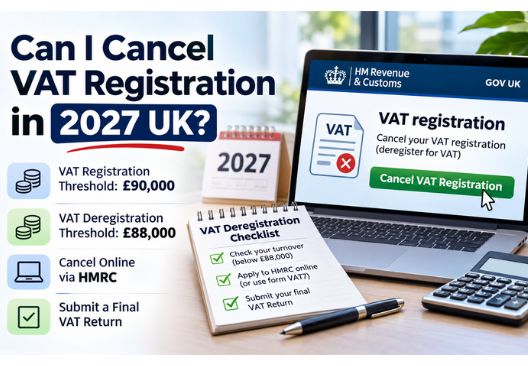
That distinction matters because the UK has separate thresholds for registering and deregistering. From April 2027, the VAT registration threshold remains £90,000, while the VAT deregistration threshold remains £88,000.
If your business is already VAT registered and you expect your VAT-exclusive taxable turnover over the next 12 months to remain within the deregistration limit, you may be able to ask HMRC to cancel your registration. In other circumstances, such as permanently stopping taxable trading, cancellation may be compulsory rather than optional.
This guide explains when you can cancel VAT registration in 2027 UK, the HMRC VAT deregistration threshold, how to cancel VAT registration online, and what happens to your VAT obligations afterwards.
If you are comparing deregistration with the rules for joining the VAT system, read our VAT Registration UK 2026 guide.
Can I Cancel VAT Registration in 2027 UK?
Yes, but whether you can or must cancel depends on why you are leaving the VAT system.
For voluntary cancellation based on turnover, HMRC requires you to show that your VAT-exclusive taxable turnover for the next 12 months will not exceed the VAT registration cancellation limit. HMRC may ask why turnover is expected to fall and what you expect your taxable turnover to be during that period.
This means a business should not look only at last year's accounts or a few slow trading months.
You should consider:
-
current taxable sales;
-
confirmed future contracts;
-
recurring income;
-
expected customer orders;
-
changes to trading activity; and
-
your realistic taxable turnover forecast for the next 12 months.
You may also have to cancel your VAT registration if you stop making taxable supplies, sell the business in certain circumstances, change legal status, join a VAT group, or otherwise cease to be eligible for registration. HMRC requires businesses that are no longer eligible to notify it within the applicable timeframe; failing to report relevant changes within 30 days can lead to a penalty.
Key takeaway: A fall in turnover does not cancel VAT registration automatically. You remain VAT registered until HMRC formally cancels your registration.
HMRC also states that you should continue charging and accounting for VAT until cancellation has been confirmed.
Example 1: Turnover Has Fallen After Losing a Contract
A VAT-registered consultancy previously generated £105,000 of taxable turnover each year.
Its largest client terminates a long-term contract, and the business forecasts only £72,000 of VAT-exclusive taxable turnover for the coming 12 months. There are no replacement contracts expected to take turnover back above the cancellation limit.
In this situation, the business may have reasonable grounds to apply for voluntary VAT deregistration.
Before applying, the owner should prepare evidence supporting the forecast, such as contract termination documents, current sales figures and expected work.
Example 2: Sales Have Fallen Temporarily
A VAT-registered retailer normally generates around £100,000 of taxable turnover.
A weak trading period temporarily reduces sales, but confirmed orders and seasonal demand indicate that taxable turnover for the next 12 months is likely to reach £96,000.
The business should not assume that the temporary fall makes it eligible for deregistration.
Key takeaway: HMRC's test is forward-looking. Base a voluntary deregistration application on a realistic next-12-month turnover forecast, not simply a recent drop in sales.
Accurate records are important when calculating your position. If your bookkeeping is behind, review the figures before making the application through appropriate bookkeeping services.
What Is the HMRC VAT Deregistration Threshold in 2027?
The HMRC VAT deregistration threshold is £88,000 from April 2027.
Budget 2026 confirms the following VAT thresholds:
| VAT Threshold | From April 2027 |
|---|---|
| VAT registration threshold | £90,000 |
| VAT deregistration threshold | £88,000 |
These figures serve different purposes.
The £90,000 registration threshold determines when many UK-established businesses must register for VAT. HMRC says registration is required where taxable turnover for the previous 12 months exceeds £90,000 or where the business expects to exceed £90,000 within the next 30 days.
The £88,000 deregistration threshold applies when an already VAT-registered business wants to leave the VAT system voluntarily because its expected taxable turnover has reduced.
VAT Registration Threshold vs VAT Deregistration Threshold
A common mistake is assuming that turnover below £90,000 automatically allows VAT cancellation.
It does not.
Consider a business expecting £89,000 of taxable turnover over the next 12 months.
That figure is below the £90,000 registration threshold, but it is still above the £88,000 deregistration limit. The business should therefore not assume it qualifies for voluntary cancellation on turnover grounds.
The difference between the two thresholds helps prevent businesses moving repeatedly in and out of VAT registration when turnover fluctuates close to the registration limit.
HMRC's detailed guidance also requires turnover for voluntary deregistration purposes to be considered on a VAT-exclusive basis.
Key takeaway: For VAT deregistration in 2027, focus on the £88,000 cancellation limit and your expected VAT-exclusive taxable turnover over the following 12 months.
There is also an important exception for non-established taxable persons (NETPs). HMRC states that the normal UK deregistration limit is not available to NETPs on reduced-turnover grounds.
How to Cancel VAT Registration UK Online in 2027
If you are wondering, “Can I cancel VAT registration in 2027 UK online?”, the answer is yes in many ordinary cases.
HMRC currently allows online cancellation where, for example:
-
you have stopped trading and are not part of a VAT group;
-
your taxable turnover is below the applicable deregistration limit;
-
you have stopped making VAT-taxable goods or services; or
-
you are applying for an exemption because most or all of your sales are zero-rated.
Step 1: Confirm Why You Are Deregistering
Determine whether your cancellation is:
Voluntary — typically because expected taxable turnover has fallen sufficiently; or
Compulsory — because you have stopped making taxable supplies or are otherwise no longer eligible to remain VAT registered.
This distinction can affect the cancellation date and information HMRC requires.
Step 2: Prepare Your Turnover Information
If you are cancelling because turnover has reduced, prepare a realistic forecast covering the next 12 months.
HMRC may expect you to explain why turnover will remain below the cancellation limit. Reasons could include losing a contract, reducing trading hours or making a significant change to business operations.
Do not submit an artificially low forecast simply to obtain deregistration. Use evidence that reflects the actual commercial position of the business.
Step 3: Apply Through Your HMRC VAT Online Account
You can use HMRC's online cancellation service when your circumstances qualify.
You will need your VAT online account sign-in details.
For the official process, see HMRC guidance on cancelling VAT registration.
Step 4: Use VAT7 Where Online Cancellation Is Not Available
Some situations require cancellation by post using form VAT7.
HMRC lists circumstances including:
-
a change in legal status where a new VAT registration number is required;
-
selling the business where the new owner will not keep the existing VAT number;
-
disbanding a VAT group; and
-
certain liquidation situations.
For the detailed rules, see HMRC VAT Notice 700/11 – Cancelling Your Registration.
Step 5: Keep Charging VAT Until Cancellation Is Confirmed
Do not stop adding VAT simply because you have submitted the application.
For voluntary cancellation, HMRC states that the cancellation date can normally be the date HMRC receives the application or a later date agreed with HMRC. Reduced-turnover deregistration cannot simply be backdated to an earlier date of your choosing.
Continue charging and accounting for VAT until HMRC confirms the cancellation.
HMRC says confirmation will usually arrive within 40 working days, although it may take longer during busy periods.
Key takeaway: Applying for VAT deregistration and actually being deregistered are not the same thing. Continue meeting your VAT obligations until HMRC confirms the effective cancellation date.
What Happens After You Cancel VAT Registration?
VAT deregistration creates several final compliance obligations.
It is not simply a matter of receiving confirmation and removing the VAT number from your invoices.
Stop Charging VAT From the Cancellation Date
HMRC's confirmation will state your official cancellation date.
From that date, you must stop charging VAT and must not issue invoices showing your cancelled VAT registration number.
Make sure your:
-
invoicing software;
-
website;
-
quotation templates;
-
recurring invoices;
-
accounting system; and
-
sales documentation
are updated from the correct date.
Submit Your Final VAT Return
You will generally need to submit a final VAT Return covering the period up to and including your cancellation date.
HMRC states that the return must be submitted by its due date and should include any outstanding VAT, including VAT due on qualifying stock and assets.
Do not delay the final return simply because some purchase invoices have not yet arrived. HMRC provides a separate mechanism for certain post-deregistration VAT claims.
Check VAT on Stock and Business Assets
VAT may become due on certain stock and assets held when registration ends.
HMRC explains that a deemed supply can arise on assets such as:
-
unsold stock;
-
plant and equipment;
-
furniture;
-
commercial vehicles;
-
computers; and
-
certain interests in land.
The rule generally applies where VAT was claimed when the assets were acquired or other relevant conditions are met.
However, HMRC states that you will not have to account for VAT if the total VAT due on the relevant assets is £1,000 or less.
This calculation can be particularly important for businesses holding significant stock or valuable equipment.
Keep Your VAT Records
HMRC requires VAT records to be retained for six years after cancellation. The formal cancellation notice should also be retained with those records.
Be Prepared to Register Again
VAT deregistration does not prevent a business from becoming VAT registered again.
If your business grows and becomes liable for VAT registration in the future, you must register again at the appropriate time. HMRC warns that penalties can apply where a business fails to register when required.
If your business structure or financial reporting is also changing, review the impact alongside your company accounts requirements.
Should You Cancel VAT Registration in 2027?
Being eligible to deregister does not necessarily mean deregistration is the best commercial decision.
The effect depends heavily on who your customers are, how much input VAT you incur, your pricing strategy and whether turnover is likely to increase again.
Deregistration may be attractive where a business mainly sells to consumers who cannot reclaim VAT. Removing VAT from future pricing may give the business more flexibility over its customer-facing prices or margins.
On the other hand, remaining registered may still be worth considering where:
-
most customers are VAT-registered businesses;
-
the business incurs substantial VAT-bearing expenses;
-
major capital expenditure is planned;
-
turnover is likely to rise again soon; or
-
leaving and later re-entering the VAT system would cause unnecessary administration.
Example: B2C Service Business
A service provider has forecast taxable turnover of £72,000, and most customers are private individuals.
Because those customers cannot normally recover the VAT charged to them, deregistration could provide more pricing flexibility once HMRC approves the cancellation.
The owner should still compare the pricing benefit with the loss of the ability to recover VAT on eligible business purchases.
Example: B2B Consultancy
A consultancy forecasts taxable turnover of £80,000, but nearly all its customers are VAT-registered companies.
Its clients can generally recover VAT subject to the normal rules, while the consultancy incurs VAT on software, equipment and professional services.
In that situation, the commercial benefit of cancelling may be limited, even if the consultancy qualifies to apply.
Key takeaway: Treat the £88,000 threshold as an eligibility test, not an automatic recommendation to deregister.
Before applying, compare:
expected taxable turnover + customer type + input VAT + pricing impact + future growth plans.
If you need help reviewing your position, TaxVATReturn provides VAT registration support.
Frequently Asked Questions About VAT Deregistration UK 2027
Can I cancel VAT registration in 2027 UK online?
Yes, HMRC allows online VAT cancellation in many circumstances, including where qualifying taxable turnover has fallen below the deregistration limit or the business has stopped making taxable supplies. Other cases must be dealt with using form VAT7.
What is the HMRC VAT deregistration threshold in 2027?
The VAT deregistration threshold remains £88,000 from April 2027. The VAT registration threshold remains £90,000.
Can I deregister for VAT if my turnover is below £90,000?
Not simply because turnover is below £90,000.
For voluntary turnover-based cancellation, the relevant limit is £88,000, and HMRC considers expected VAT-exclusive taxable turnover for the following 12 months.
Is VAT deregistration automatic when turnover falls?
No.
You must apply to HMRC where you want voluntary cancellation. Continue charging and accounting for VAT until HMRC confirms that your registration has ended.
How long does HMRC VAT deregistration take?
HMRC says it will usually contact you about the cancellation within 40 working days, although processing can take longer during busy periods.
Can HMRC refuse VAT deregistration?
Yes.
For voluntary deregistration, HMRC must be satisfied that the relevant conditions are met. HMRC may refuse the request if it is not satisfied with the expected turnover position or other eligibility requirements. Its guidance also contains specific restrictions on when reduced-turnover cancellation can be used.
Can VAT deregistration be backdated?
You generally cannot request retrospective voluntary cancellation simply because your turnover had previously fallen below the threshold. HMRC says voluntary cancellation normally takes effect from the application date or a later agreed date.
Do I need to submit a final VAT Return?
Usually, yes.
Unless the VAT number is being transferred to someone taking over the business as a going concern, HMRC requires a final VAT Return.
Do I have to pay VAT on stock when deregistering?
Possibly.
You may have to account for VAT on qualifying stock and assets held on the cancellation date. HMRC says no VAT is due under this rule where the total VAT due on those assets would be £1,000 or less.
Final Takeaway
Yes, you can cancel VAT registration in 2027 UK if you meet HMRC's conditions.
For voluntary turnover-based deregistration, the key figure is the £88,000 VAT deregistration threshold, not the £90,000 registration threshold.
Before submitting an application, check your expected VAT-exclusive taxable turnover for the next 12 months, understand whether cancellation is voluntary or compulsory, and calculate any potential VAT due on stock or assets.
Most importantly, do not stop charging VAT until HMRC confirms your official cancellation date.
A careful review before deregistration can prevent incorrect VAT invoices, missed final-return obligations, unexpected VAT on assets and the disruption of having to register again shortly afterwards.
Recent Article